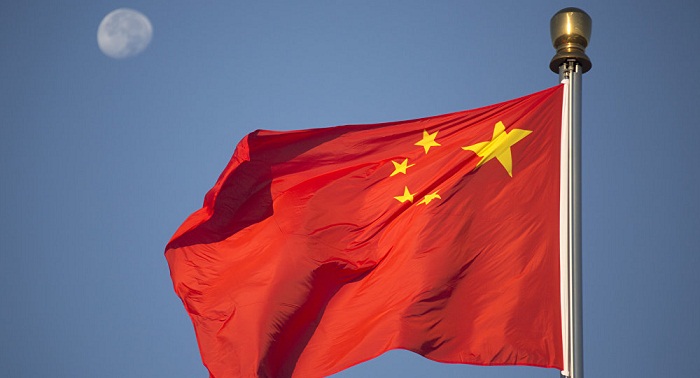
China's new security law for Hong Kong envisages setting up an office in the territory to gather intelligence and handle crimes against national security, state media say.
The new security law will also override any local laws that conflict with it, Xinhua news agency reported.
The planned law has sparked protests and drawn international condemnation.
Critics say it will destroy the freedoms Hong Kong enjoys but which are not available in mainland China.
On Friday the European Parliament voted to take China to the International Court of Justice in The Hague if the law was imposed.
But China says the law is needed to tackle separatist activity, subversion, terrorism and collusion with foreign elements and rejects criticism a interference in its affairs.
Hong Kong was handed back to China from British control in 1997 under an agreement centring on a "one country, two systems" principle that guaranteed certain freedoms for Hong Kong and that do not apply in the mainland.
What is in the new law?
Details were published after a three-day meeting of the main decision-making body in China's parliament, the Standing Committee of the National People's Congress.
A new national security office in Hong Kong would deal with national security cases, but would also have other powers such as overseeing education about national security in Hong Kong schools.
Xinhua also said that Hong Kong's leader Carrie Lam would be able to appoint specific judges to hear national security cases.
Ms Lam has backed the proposed law and has denied that Hong Kong's freedoms under the "one country, two systems" will be affected.
The Hong Kong government will be required to carry out most enforcement under the new law, but Beijing will be able to overrule the Hong Kong authorities in some cases.
"If the local laws... are inconsistent with this Law, the provisions of this Law shall apply. The power to interpret this law belongs to the Standing Committee of the National People's Congress," Xinhua said.
BBC
More about: Beijing


-1780923278.jpg&h=190&w=280&zc=1&q=100)