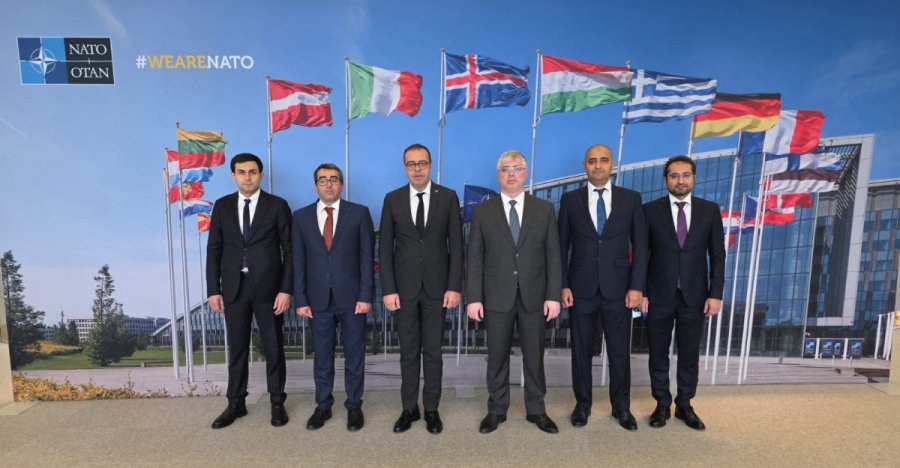
From October 28 to 30, a delegation led by Samir Poladov, Deputy Chairman of the Board of the Azerbaijan Mine Action Agency (ANAMA), visited the headquarters of the North Atlantic Treaty Organization (NATO) in Brussels, Belgium.
During the visit, the delegation held meetings with several NATO officials, including Orhan Muratli, Head of the Operations Support Unit of the NATO Support and Procurement Agency (NSPA); Stergios Isaakidis, Uncrewed Aerial Systems (UAS) Programme Manager; Piers Cazalet, Director of the Operations Division; Eyup Turmus, Head of the NATO Science for Peace and Security (SPS) Unit; Krisztian Meszaros, Director for Partnerships and Global Affairs; and Eirini Lemos Maniati, Head of the Arms Control, Disarmament, and Non-Proliferation Section.
The Azerbaijani delegation also participated in the meeting of the Ad Hoc Working Group on Small Arms and Light Weapons (SALW) and Mine Action (MA) of the Partnership and Cooperative Security Committee in the Euro-Atlantic Partnership Council (EAPC) format.
Discussions focused on the current state of cooperation between Azerbaijan and NATO in humanitarian demining, the importance of international support in this field, and progress within the Science for Peace and Security (SPS) Programme on innovative demining methods. The sides also discussed Azerbaijan’s participation in ongoing and future SPS projects involving next-generation technologies and innovative approaches, as well as plans to organize joint trainings and workshops in Azerbaijan and establish a NATO Trust Fund for the country.
Samir Poladov noted that since November 2020, 410 Azerbaijani citizens have been killed or injured by landmines, stressing that mines significantly hinder the return of former internally displaced persons (IDPs), delay reconstruction and restoration works, and cause serious humanitarian, economic, and environmental consequences. He also briefed NATO officials on ANAMA’s use of advanced technologies, including mechanical demining equipment and new field-based approaches, to address the landmine challenge.
More about:


-1780923278.jpg&h=190&w=280&zc=1&q=100)