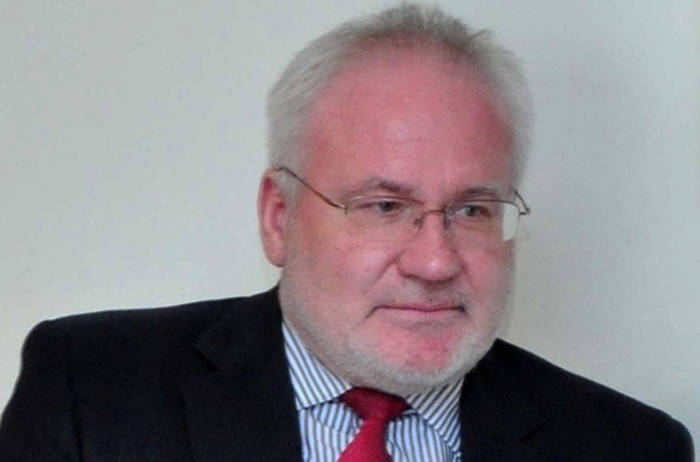
OSCE Minsk Group Russian Co-Chair Igor Popov’s interview with APA.
- The recent escalation of the situation on the line of contact of Azerbaijani and Armenian armies caused losses from both sides. The co-chairs made a statement in this regard but avoided announcing to whom the responsibility of the tensions falls on. What’s your opinion on this matter?
- The parties to the conflict have repeatedly declared their commitment to solve the conflict and disputed issues by peaceful, political and diplomatic means. However, the recent use of artillery, heavy machine guns and multiple rocket launchers on the contact line of troops and along the Azerbaijani-Armenian border lead to the intensification of clashes. There is a significant increase in the number of causalities among civilians. The parties traditionally impose responsibility on each other for the violation of the ceasefire. The cases which you mentioned are no exception. However, neither the OSCE co-chairs nor its monitoring mission have the opportunity to identify the perpetrators without adequate investigations.
- As you know, none of the proposals that had been made until now, failed to contribute to the rapprochement of the parties. Are there any new proposals in connection with an early resolution of the Nagorno-Karabakh conflict?
- I don’t agree with your conclusions. Thanks to the assistance of mediators, it was managed to bring the parties’ positions on many controversial points. Base principles for the settlement of the conflict were agreed upon. They are well known to everyone, the OSCE Minsk Group co-chairs have repeatedly mentioned them in their statements. The parties don’t reject the agreed basic principles, they have different vision on the sequence of their implementation. The matter is not about cardinal change of approaches or refusing everything achieved from the settlement process. The main task is to help the parties find a balanced solution through making necessary corrections to already achieved results. The OSCE Minsk Group co-chairs are working in this direction. We have recently met with the foreign ministers of both Azerbaijan and Armenia in New York. We are planning to visit the region at the end of this month to clarify the positions of the Azerbaijani and Armenian leadership. We are going to go to Karabakh as well. In parallel with it, Russia is making independent efforts within the approaches agreed by co-chairs. Our high-level relations with Yerevan and Baku are always focused on the settlement of the Nagorno-Karabakh conflict. The conflict’s settlement was thoroughly discussed during Azerbaijani and Armenian foreign ministers’ visit to Moscow in April-May. Outcomes of all this collective work can be considered at the next Armenian-Azerbaijani summit. Of course, the final decision depends on Yerevan and Baku. We are planning to hold a detailed discussion on it during our trip to the region.
- The US analytical company Stratfor published an article about Russia’s intention to deploy peacekeepers to Nagorno-Karabakh. Are there any discussions on this issue?
- I will not comment on the article. Let these conclusions remain on the conscience of company’s “analysts”. In practical terms, the issue of the deployment of peacekeepers can be raised upon a key agreement on the Nagorno-Karabakh conflict. The beginning of operation of the multinational peacekeeping forces must precede the adoption of the relevant resolution of the UN Security Council, as required by decision of the Budapest summit of the OSCE. The countries intending to send peacekeepers will form the contingent upon the consent of the conflicting parties.
- Armenian President Serzh Sargsyan in one of his recent statements said that Nagorno-Karabakh is an integral part of Armenia. How do you think, does this statement undermine the negotiation process and confirm the fact of occupation?
- Consistent concentration on informative and propagandist background, for what there are enough reasons in recent times, has a negative impact on the negotiation process. As for the status of Nagorno-Karabakh, this should be determined on the basis of the agreement of the parties.
`Our high-level relations always focused on Nagorno-Karabakh`
16 October 2015
Read: 2358


-1780923278.jpg&h=190&w=280&zc=1&q=100)