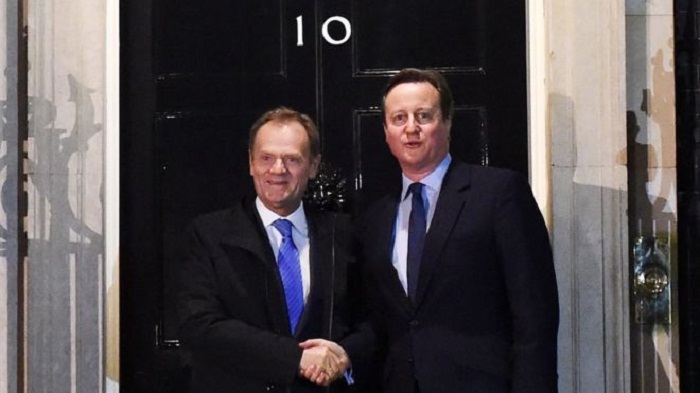
Mr Tusk said "intensive work" would be needed during the coming hours.
The aim is to agree a deal to be put to EU leaders ahead of a summit on 18 and 19 February.
An early deal would allow Mr Cameron to call a referendum on the UK`s EU membership before the school summer holidays.
After their meeting over dinner on Sunday night, Mr Cameron tweeted that Mr Tusk had agreed to another 24 hours of talks before publishing the UK`s draft renegotiation text.
Mr Tusk, whose council is comprised of the leaders of other EU states, tweeted: "No deal yet. Intensive work in next 24 crucial. #UKinEU".
After the 24-hour period has passed, negotiators will decide whether to table a draft agreement or not.
The BBC`s assistant political editor, Norman Smith, said: "Although no final agreement has been reached on any of the four areas - immigration, sovereignty, competitiveness and protection for non euro countries - sources suggest this is because of the complexity of the deal and the need to make sure it is legally watertight.
"Number 10 suggests one of the main area of dispute at the moment centres on plans to give the UK and other non-euro countries greater safeguards."
`Emergency brake`
As part of his attempts to renegotiate the UK`s EU membership, Mr Cameron has proposed denying in-work benefits to all EU migrants until they had been in the UK for four years.
He said stopping those migrants from claiming tax credits - income supplements paid to those in low-paid work - would reduce high levels of immigration to the UK.
EU leaders rejected this idea but suggested an "emergency brake" which the UK could use for up to four years.
The UK could use this to deny in-work benefits to EU migrants, but it would have to prove public services were under excessive strain and would need the approval of other EU states.
The proposal was to allow the UK to be able to impose the brake within three months of applying for it, but Mr Cameron wants it triggered immediately after the EU referendum. He also says there should be no time limit on its use.
A deal isn`t a deal until, well, it`s a deal. And there isn`t one yet.
Donald Tusk`s remarks on leaving Downing Street on Sunday appeared stark.
"No deal," he said, to waiting reporters.
But a concrete deal on Sunday was always unlikely: with the next EU summit still over a fortnight away, there`s still plenty of time for negotiation.
This latest calling point in the discussions was fuelled, we were told, by smoked salmon, fillet of beef and pear and apple crumble.
Such sustenance didn`t provide stamina for Messrs Cameron and Tusk to talk into the night: in less than two hours, Mr Tusk was gone.
But their teams continue to talk; a "crucial" 24 hours beckons, we are told.
There could, though, be rather a lot of "crucial 24 hours" between now and referendum day, whenever that turns out to be.
After Sunday`s talks, the prime minister`s spokesman said: "Progress has been made in the past 48 hours, but we are not there yet."
He said the European Commission had tabled a text saying the UK meets the criteria for triggering the proposed emergency brake, describing this development as a "significant breakthrough".
This means Mr Cameron could deliver on his commitment to restrict in-work benefits to migrants for four years, he added.
More about:


-1780923278.jpg&h=190&w=280&zc=1&q=100)