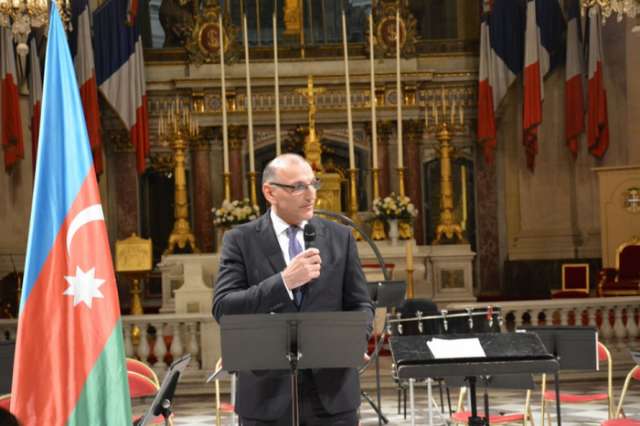
H.E. Elchin Amirbayov, Azerbaijani Ambassador to France, said: “Up to this day, this massacre sadly remains unknown by French society and constitutes the most terrible episode in the conflict between Armenia and Azerbaijan. The extent of this massacre is comparable with that in Oradour-sur-Glane during World War II, which has left indelible traces in the memories of our French friends. This massacre, which was intended to provoke panic amongst a fleeing population, was followed by a policy of ethnic cleansing, which saw almost a million Azerbaijanis forced to leave their historic territories, whilst Nagorno-Karabakh and the seven surrounding regions were occupied, accounting for around 20 per cent of their country.
“We must never let these innocent victims be forgotten! The Khojaly Massacre is engraved on the spirit of all Azerbaijanis. But, Khojaly is also a voice that must be heard across the world. This is due to the international Justice for Khojaly campaign that was launched on 8 May 2008 by Mrs Leyla Aliyeva, Vice-President, Heydar Aliyev Foundation. Thanks to this campaign, several countries around the world have recognised this act of barbarity. The event today fits perfectly within the structure of this campaign, with the principal objective of achieving the restoration of justice in the region.”
Marie-Laetitia Gourdin, Director, TEAS France, said: “I would like to thank our partner organisations, with whom we are associated this evening, under the communal banner of the international Justice for Khojaly campaign. It is an honour for TEAS to be represented at the prestigious Cathédrale St-Louis des Invalides to render homage, together, to the memory of the Khojaly Massacre victims.
“History is always the subject of debate and interpretation, and this evening’s commemoration is not intended to stir tensions, but to ensure that such atrocities are not repeated. The tragedies of today should not cause us to forget those of yesterday. The millions of refugees today must not make us forget the approximately one million Azerbaijanis who have been waiting for more than 20 years to regain their lands that are still occupied by Armenian troops.
“Tonight’s concert notably features a work by Pierre Thilloy that is particularly touching, commissioned by TEAS, and entitled Khojaly 613. This work pays homage to the soul of the victims of the massacre. As Pablo Casals, the famous Spanish cellist, orchestral leader and composer said: “Music hunts hatred for those who are without love. It gives peace to those who are without sleep, and consoles those who cry.”
She added: “Tonight’s concert aims at giving some closer to the victims. Justice and peace is the only path Azerbaijan and Armenia should take to eventually live in harmony as neighbours, as they did in the past.”
Mirvari Fataliyeva, General Secretary, Association des Amis de l’Azerbaidjan, said: “The events of Khojaly date back to 1992 and leave a deep wound for all Azerbaijanis and all friends of our country. This gathering, commemorating this sad date, is also there to remind us of the horror of all massacres committed in the world. Last year, we joined TEAS and the Azerbaijani Embassy in France to organise the first screening of the independent documentary Endless Corridor in Paris, and in 2016 we are organising a panel discussion Khojaly – the truth about a massacre in the National Assembly. This date must not be forgotten, so we will continue to discuss it and will support the Justice for Khojaly campaign, launched a few years ago.”
L’Orchestre Lamoureux, under the baton of Azerbaijani conductor Ayyub Guliyev, performed the concert. This orchestra is well-versed in playing Azerbaijani classical repertoire, as the Artistic Director is Pierre Thilloy, Director-General of the Festival De Soie et de Feu (Of Silk and Fire Festival) and former Composer-in-Residence for the French Embassy in Azerbaijan. It aptly began with the Funeral Ode by Gara Garayev in the arrangement by Mustafa Mehmandarov, and also included Azerbaijani works by Vasif Adigezalov and Fikret Amirov.
European pieces included the Dream of Mengele by the composer, clarinettist and writer Hélios Azoulay, a disturbing work inspired by the hideous, sadistic experiments of Josef Mengele on inmates of the Auschwitz Concentration Camp; and the Adagio for Strings by Samuel Barber, a poignant and emotional piece featuring a gently ascending and descending melody that is frequently performed at funerals.
The commemoration concluded with a performance of the tone poem Khojaly 613 by French composer Pierre Thilloy, played in the presence of the composer, featuring Azerbaijani violinist Sabina Rakcheyeva, the first Azerbaijani graduate from the Juilliard School in New York and Cultural Advisor, TEAS, and Hélios Azoulay on clarinet.
The evening was dedicated to the memory of the Khojaly victims and those Azerbaijanis who have one wish – to return home and live in peace with their neighbours.
More about:


-1780923278.jpg&h=190&w=280&zc=1&q=100)