Premier Li Keqiang made the announcement in his opening speech, warning of a "difficult battle" ahead.
The annual meeting in Beijing sets out to determine both the economic and political agenda for the country.
It comes at a time when China struggles with slowing economic growth and a shift away from overreliance on manufacturing and heavy industry.
The party congress is also expected to approve a new five-year plan, a legacy of the communist command economy.
Why China`s party congress matters
Economic woes
"China will face more and tougher problems and challenges in its development this year, so we must be fully prepared to fight a difficult battle," Mr Li told delegates on Saturday.
Last year, China`s goal was "about 7%". The economy actually grew by 6.9% - the lowest expansion in 25 years.
Mr Li also said that China was targeting consumer inflation at "around 3%" and unemployment "within 4.5%".
Meanwhile, the country`s defence spending will be raised by 7.6%, the state-run Xinhua news agency reports, citing a budget report.
China`s congress is a highly choreographed, largely rubber stamp affair, but Premier Li`s opening address can at least be gleaned for clues about the overall direction of policy, the BBC`s John Sudworth in Beijing reports.
There was plenty of talk about "painful rebalancing", the need to reform inefficient state owned enterprises and to cut overcapacity - but for many, this speech will look a lot like business as usual: a commitment to growth at all costs, our correspondent adds.
Analysis: Karishma Vaswani, BBC Asia business correspondent
As expected, China released an economic growth target at the opening session of the NPC.
But this was the first time we saw a range set instead of a hard and fast number. A recognition that China`s growth may slip below the 6.9% recorded last year, yes, but economists have long said that a growth range may indicate a more accommodating stance towards much-needed structural reforms.
Why does this matter to the rest of us? Well, China is now the world`s second largest economy and has been a massive consumer of a lot of the stuff Asian businesses are selling. So while a slowdown will inevitably impact Asia in the short term, it`ll be more important to see whether China`s growth, slowing or not, will transition to a more sustainable path.
This year`s congress is overshadowed by the current economic strains as China experiences slowing economic growth and extreme volatility in stock markets.
China GDP focus at National People`s Congress meeting
The stock market slump had seen indexes lose more than 30% of their value in 2015 and led to large-scale government intervention of limited success.
Beijing has also been accused of guiding the yuan currency lower to boost the competitiveness of Chinese exports on the global market.
A slew of weak economic data has recently added to the concerns and US ratings agency Moody`s has downgraded its outlook for China from "stable" to "negative".
China PM predicts `battle` for growth as target cut
05 March 2016
Read: 1141
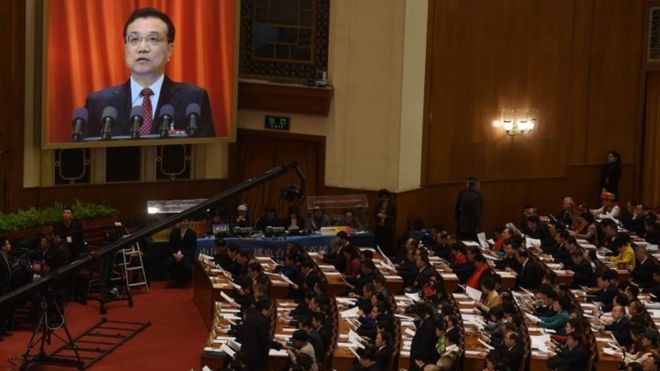
China`s National People`s Congress has set the country`s growth target for 2016 at a lower range of 6.5%-7%.


-1780923278.jpg&h=190&w=280&zc=1&q=100)