Obama`s state visit to Argentina coincided with the 40th anniversary of the coup that began a seven-year crackdown on Marxist rebels, labor unions and leftist opponents, during which security forces killed 30,000 people.
"There has been controversy about the policies of the United States early in those dark days," Obama said while visiting a memorial park in Buenos Aires dedicated to victims of the dictatorship.
"Democracies have to have the courage to acknowledge when we don`t live up to the ideals that we stand for. And we`ve been slow to speak out for human rights and that was the case here," he said.
At the memorial, which sits on the banks of the La Plata River, he and Argentine President Mauricio Macri dropped white roses into the water in an act of commemoration.
Survivors of the crackdown say one of the military rulers` tactics was the use of so-called "death flights", where political opponents were tossed into aircraft, stripped naked and then thrown alive into the river and the Atlantic Ocean to drown.
Obama has promised to declassify U.S. military and intelligence records related to the dictatorship-era, a time when Cold War thinking often put Washington behind right-wing governments in Latin America.
But the U.S. leader was criticized by some rights activists. One group of victims` relatives labeled the timing of his visit a provocation.
"We will not allow the power that orchestrated dictatorships in Latin America and oppresses people across the world to cleanse itself and use the memory of our 30,000 murdered compatriots to strengthen its imperialist agenda," the Buenos Aires-based Center for Human Rights Advocates said in a statement.
Some Argentines welcomed Obama`s gestures. "Obama is not going to say outright `forgive us`, but he`s saying it through his actions," said Daniel Slutzky, a 75-year-old college professor.
Obama said on Wednesday it was "gratifying to see Argentina champion our shared commitment to human rights." Yet Macri`s opponents balk at the suggestion the socially conservative leader is a rights defender.
Obama`s visit to Argentina is a show of support for Macri`s sharp turn away from the nationalist policies of his predecessor, Cristina Fernandez, who frequently railed against the United States and Wall Street.
The U.S. president flew to Argentina from Cuba, where he challenged President Raul Castro on human rights and political freedoms even as the two men cast aside decades of hostility that began soon after Cuba`s 1959 revolution.
Obama has been traveling with his family and later on Thursday they were to switch briefly into vacation mode, traveling to the lakeside town of Bariloche in Patagonia for the afternoon before returning to Washington.
U.S. too slow to speak out on human rights in Argentina`s `Dirty War` - Obama
25 March 2016
Read: 2052
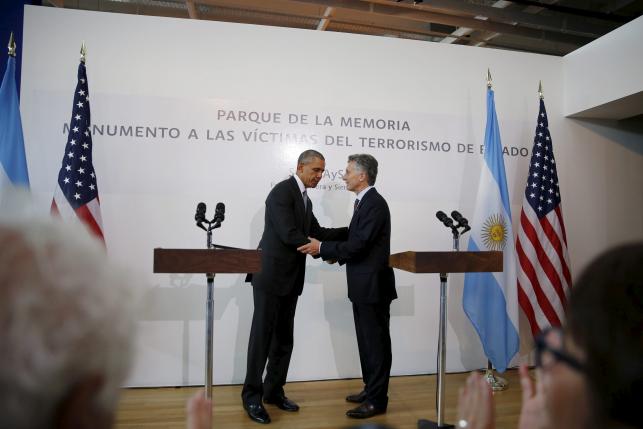
President Barack Obama said the United States was too slow to condemn human rights violations during Argentina`s 1976-1983 dictatorship as he honored victims of the "Dirty War" on Thursday, but he stopped short of apologizing for Washington`s early support of the military junta.


-1780923278.jpg&h=190&w=280&zc=1&q=100)