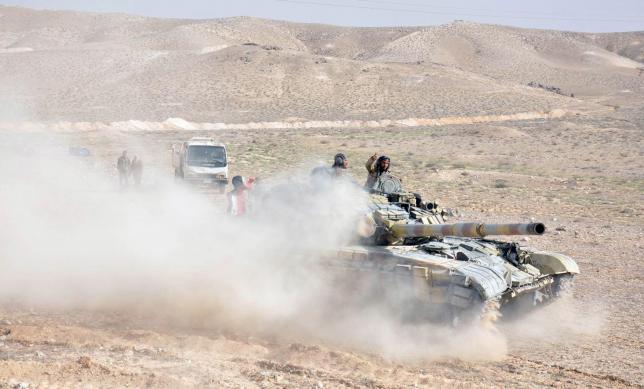
Observatory director Rami Abdulrahman said Syrian soldiers and allied militias had taken control of one-third of Palmyra, mainly in the west and north, including parts of its ancient Roman-era ruins. Soldiers were also fighting on a southern front, he said.
State-run television also said the army was advancing inside Palmyra, recapturing several neighborhoods.
Television footage from the slopes of the medieval citadel, which was seized by the army on Friday and overlooks the city, showed tanks and armored vehicles firing into Palmyra.
Waves of explosions hit buildings, and smoke could be seen rising from many locations. Earlier, the Observatory said that Islamic State militants had launched counter-attacks - including car bombings - against advancing soldiers.
The recapture of Palmyra, which the Islamist group seized in May 2015, would mark the biggest reversal for Islamic State in Syria since Russia`s intervention turned the tide of the five-year conflict in President Bashar al-Assad`s favor.
The group, and al Qaeda`s Syrian branch the Nusra Front, is excluded from a month-long cessation of hostilities agreement that has brought a lull in fighting between the government and rebels battling Assad in western Syria.
The limited truce has allowed peace talks to resume in Geneva. But progress has been slow, with the government and its opponents disagreeing fundamentally on the terms of such a transition, including whether Assad must leave power.
More about:


-1780923278.jpg&h=190&w=280&zc=1&q=100)