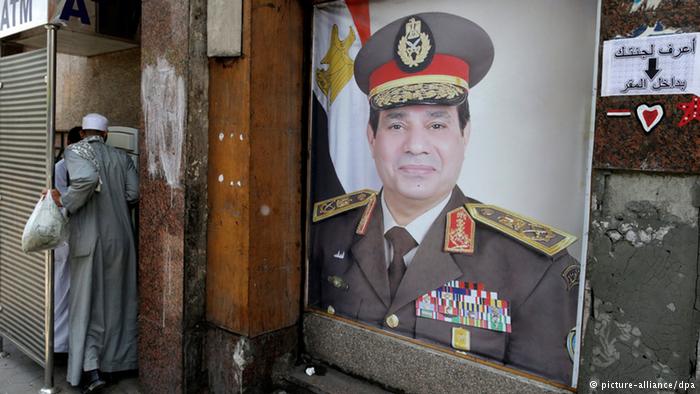
Since the accession of Egyptian President Abdel-Fattah el-Sissi to power following a 2013 military coup on the back of popular protests against Egypt`s first democratically elected president, the security situation has deteriorated.
While it is not yet established what the hijacker intended in Egypt`s latest aviation crisis, the incident gives cause to re-examine the nation`s security situation amid an increase in terror attacks across the globe. While el-Sissi`s presidency has thus far been marked by the repression of activists, forced disappearances and waning press freedom, an insurgency in Sinai continues to erode his pledge to restore stability.
DW asked CEO Tomas Olivier of the Netherlands-based intelligence consultancy Lowlands Solutions for his appraisal of Egypt`s current security situation.
Tomas Olivier: Hijacking in itself is an extremely rare method of terrorism in modern times. During the "Golden Age" of hijacking - between the 1960s and 1990s - it was, however, a method which was commonly used for ideological purposes. The hijacking scenario in Cyprus, apparently executed by Egyptian national Seifedeen Mustafa, appears to be driven by personal motivation. However, the fact that the hijacker released all Egyptian nationals while numerous foreigners and the crew were still on board could indicate a more ideological motivation as well. It is, however, too early to draw conclusions based on the information available to us at the moment.
After the bombing of the Russian Metrojet Flight 9268 by Ansar Bayt al-Maqdis - also known as the "Islamic State in the Sinai Province" (IS-IP) - above Northern Sinai in October 2015, airport and aviation security increased in Egypt. The Egyptian authorities even decided to hire a foreign consultancy company - Control Risks - to examine airport security throughout the country. This step was announced by the Egyptian Tourism Minister Hisham Zaazou with the primary objective of demonstrating the "fact" that Egyptian airports are secure. By that time - December 2015 - Egyptian tourism was already suffering a $280-million (250-million-euro) loss a month.
Experts still have realistic doubts about the current security situation at numerous Egyptian airports. Close affiliation between airport staff, aircraft technicians and, for instance, supporters of Ansar Bayt al-Maqdis are not uncommon and remain a serious threat with regard to so-called "insider jobs," whether related to terrorism or, as reporting indicates to be most likely, personally driven, like the hijacking situation in Cyprus. The fact that it appears to be possible to smuggle in explosive devices and/or any kind of weaponry is worrying and will, once more, be an enormous blow to the already dubious reputation of general airport security in Egypt.
Egypt`s state of security in focus after plane hijacking
29 March 2016
Read: 1241
Egypt has been hit by an aircraft hijacking less than six months after a militant group downed a plane over Sinai. DW speaks to Tomas Olivier, executive of an intelligence consultancy, about Egypt`s security situation.


-1780923278.jpg&h=190&w=280&zc=1&q=100)