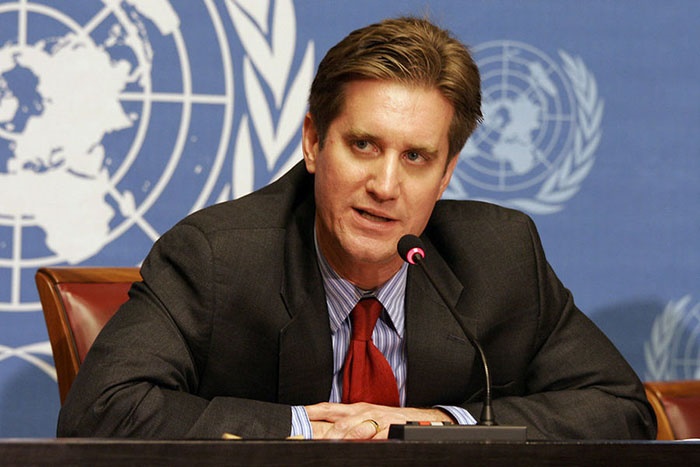
The expert said that two decades ago, the international community passed four United Nations Security Council resolutions demanding that Armenia withdraw its military forces from the occupied territories of Azerbaijan.
"Additionally, the international community formed the Minsk Group under the OSCE, which, via its U.S., French, and Russian co-chairs, helped the parties negotiate a set of basic principles that define the framework for a settlement of the Nagorno-Karabakh conflict," Bryza said.
"These basic principles derive from three core concepts of the Helsinki Final Act, namely, the territorial integrity of states, self-determination of peoples, and non-use of force," the expert added.
The conflict between the two South Caucasus countries began in 1988 when Armenia made territorial claims against Azerbaijan. As a result of the ensuing war, in 1992 Armenian armed forces occupied 20 percent of Azerbaijan, including the Nagorno-Karabakh region and seven surrounding districts. The 1994 ceasefire agreement was followed by peace negotiations. Armenia has not yet implemented four UN Security Council resolutions on withdrawal of its armed forces from the Nagorno-Karabakh and the surrounding districts.
On the night of April 2, 2016, all the frontier positions of Azerbaijan were subjected to heavy fire from the Armenian side, which used large-caliber weapons, mortars and grenade launchers.
The armed clashes resulted in deaths and injuries among the Azerbaijani population. Azerbaijan responded with a counter-attack, which led to liberation of several strategic heights and settlements. More than 370 Armenian soldiers, 12 tanks, 12 armored vehicles and 15 artillery guns have been destroyed from April 2 until today.
More about:


-1780923278.jpg&h=190&w=280&zc=1&q=100)