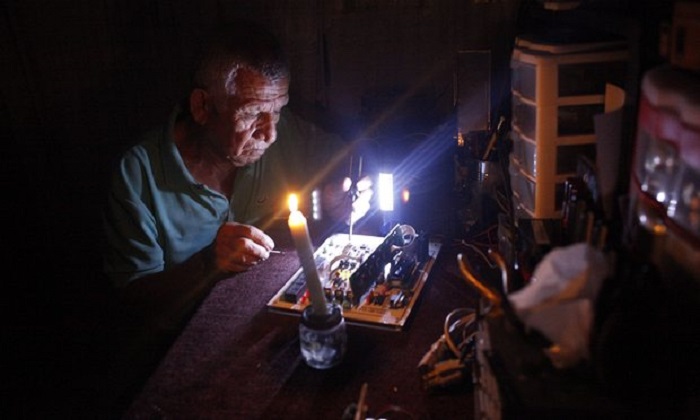
He said the water level behind the nation’s largest dam has fallen to near its minimum operating level thanks to a severe drought. Experts say lack of planning and maintenance is also to blame.
The country’s socialist administration already gave nearly 3 million public workers Fridays off earlier this month, and on Monday initiated daily four-hour blackouts around the country.
The government is now extending the Friday holidays to grade school teachers, though it appears employees of public hospitals and state-run supermarkets will still have to work.
The development came as the elections council agreed to give opposition leaders a document allowing them to begin the process of seeking a referendum to remove Maduro.
Opposition legislators chained themselves to the council’s office last week to protest its failure to provide the paperwork for the first step toward collecting the nearly 4 million signatures needed to trigger the referendum.
“Today we took a first step to begin the recall of Maduro,” opposition deputy Elias Matta tweeted. “We the people support change, there is no way to stop it.”
Venezuelans reacted with disbelief to the news that most public workers would hardly be going into the office. Workers will be paid for the days they’re sent home. Some have been using their Fridays off to wait in lines to buy groceries and other goods. Others have been going home to watch TV and run the air conditioning, leading critics to say the furlough is not an effective energy-saving measure.
Power outages have been a chronic problem. Maduro’s predecessor, Hugo Chávez, promised to solve the problem in 2010, but little has improved.
Maduro’s approval rating has plummeted amid spiraling inflation, a deep recession and widespread food shortages
Despite the dire straits the country is in, removing him from office won’t be easy.
Scheduling a referendum requires another petition drive, in which the opposition must gather signatures from 20% of the electorate, or around 4 million voters. And if the vote were ever held, the president would be removed only if the number of anti-Maduro votes exceeded the 7.6m votes he received in the 2013 election.
In December’s parliamentary elections, opposition candidates mustered only 7.7m even though they won control of the legislature by a landslide.
Timing is also of the essence for the opposition because for new elections to be called, Maduro would need to be removed by year end. After that, his six-year term ending in 2019 would be completed by his vice president — a move seen as unlikely to produce the radical change many Venezuelans are desperate for.
Still, David Smilde, a Tulane University sociologist who has lived in Venezuela for decades said the scope of the opposition’s victory, as partial as it may seem, shouldn’t be underestimated. Already, the government-stacked Supreme Court has stymied a number of laws approved by the opposition congress and on Monday struck down an attempt by lawmakers to pass a constitutional amendment cutting short Maduro’s term.
“This could’ve been a sticking point because at any point the process can get hung up for weeks or months,” said Smilde.
The immediate consequences are likely to deflate social tensions and more-strident calls for street protests like the ones that in 2014 led to the death of more than 40 people. A march called by the opposition on Wednesday to demand action from the electoral council is now being repurposed as an event to collect petition signatures, several opposition leaders said.
It’s also likely to ease international pressure on Maduro, who has been fighting criticism from the US and others that his government is blocking attempts at a peaceful democratic transition. This week, an opposition congressional delegation was scheduled to travel to Washington where they were expected to ask the Organisation of American States to initiate proceedings to suspend Venezuela from the hemispheric group.
The OAS’ Secretary General Luis Almargo, a harsh critic of the way the government tried to tilt the playing field ahead of December’s legislative elections, expressed on Twitter his “satisfaction” the “positive decision” taken by the electoral council.
More about:


-1780923278.jpg&h=190&w=280&zc=1&q=100)