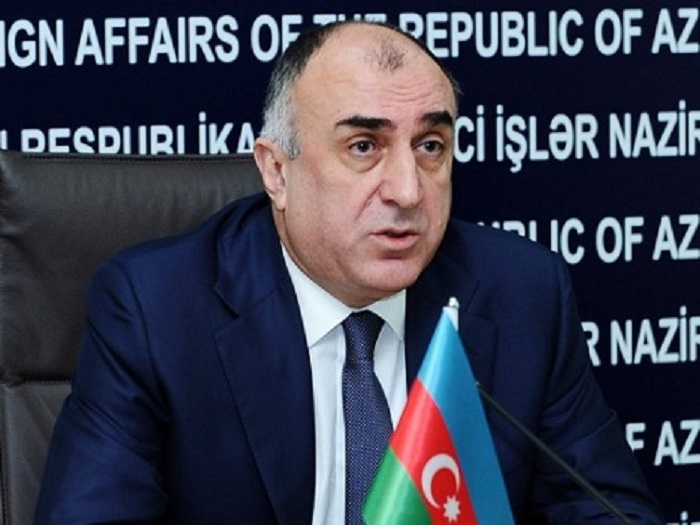
Russia’s activity as to the settlement of the Nagorno-Karabakh conflict is like an iceberg, according to Mammadyarov.
The FM noted that everyone sees only the top of the iceberg.
“But it does have lower parts too. It’s too early to elucidate the issue. A number of interesting ideas have been uttered. Still, all of them are based on the updated Madrid principles,” said Mammadyarov. “We too are amazed that Russia has put forth proposals. Russia has offered us a phased settlement. But in the first place, the Armenians must withdraw from occupied Azerbaijani lands.”
The minister also commented on Russia’s delegation to the OSCE sending a note to the Azerbaijani delegation to the OSCE on April 12.
“In 1994-1995, there were ceasefire agreements. When the ceasefire was violated in April, Azerbaijani announced that Armenia’s action undermines these agreements. Russia and the co-chairs told us that they fully support the 1994-1995 ceasefire agreements. As you know, the new stage of the ceasefire was reached in Moscow. We too think that it is important to strengthen the ceasefire,” the FM added.
He stressed that Azerbaijan is committed to negotiations on a peaceful settlement of the conflict. “But it should produce a positive outcome. That is not to say that we should negotiate for another 25 years. What we say is, let’s go forward by any means,” the FM concluded.
The Nagorno-Karabakh conflict entered its modern phase when the Armenian SRR made territorial claims against the Azerbaijani SSR in 1988.
A fierce war broke out between Azerbaijan and Armenia over the Nagorno-Karabakh region of Azerbaijan. As a result of the war, Armenian armed forces occupied some 20 percent of Azerbaijani territory which includes Nagorno-Karabakh and seven adjacent districts (Lachin, Kalbajar, Aghdam, Fuzuli, Jabrayil, Gubadli and Zangilan), and over a million Azerbaijanis became refugees and internally displaced people.
The military operations finally came to an end when Azerbaijan and Armenia signed a ceasefire agreement in Bishkek in 1994.
Dealing with the settlement of the Nagorno-Karabakh conflict is the OSCE Minsk Group, which was created after the meeting of the OSCE Ministerial Council in Helsinki on 24 March 1992. The Group’s members include Azerbaijan, Armenia, Russia, the United States, France, Italy, Germany, Turkey, Belarus, Finland and Sweden.
Besides, the OSCE Minsk Group has a co-chairmanship institution, comprised of Russian, US and French co-chairs, which began operating in 1996.
Resolutions 822, 853, 874 and 884 of the UN Security Council, which were passed in short intervals in 1993, and other resolutions adopted by the UN General Assembly, PACE, OSCE, OIC, and other organizations require Armenia to unconditionally withdraw its troops from Nagorno-Karabakh.
More about:


-1780923278.jpg&h=190&w=280&zc=1&q=100)