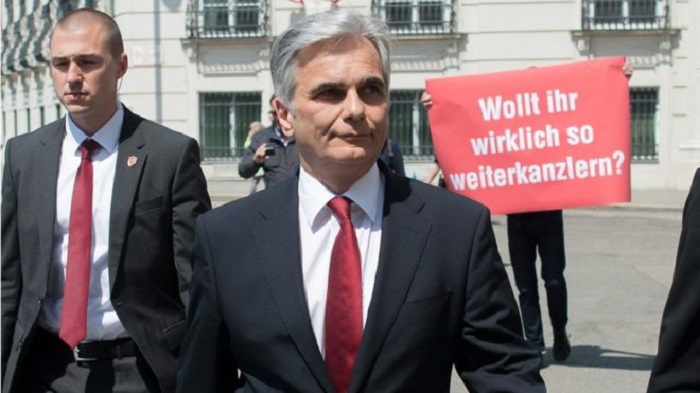
He told a news conference that Austria needed a chancellor who had his party "fully behind him".
Deputy Chancellor Reinhold Mitterlehner is to take over as chancellor on an interim basis.
Mr Mitterlehner, the leader of the junior party in the governing coalition, told Austrian news agency APA that he saw no need for fresh elections.
In his surprise resignation statement on Monday morning, Mr Faymann called for the government to make a new start.
"I`m stepping down from my role as chancellor and SPO leader," he said, acknowledging he had lost support within the party.
The two centrist parties which have dominated politics in Austria since World War Two have been losing ground to the far right for years.
It came to a head in April, when they were both trounced by the Freedom Party in the first round of the presidential elections.
But it is Mr Faymann who has now paid the price.
His Social Democrats are deeply split.
The pragmatists want to lift the ban on forming coalitions with the Freedom Party, something Mr Faymann always refused to do. The liberal wing of the party is highly critical of the increasingly tough line he took on asylum seekers and migrants.
Some are hoping for a new beginning. Others fear the political turmoil will strengthen the far right still further.
Mr Faymann singled out the challenges of bringing down unemployment, as well as social cohesion and the refugee crisis. He said he was "very grateful to have been able to serve this country".
Earlier this year, he yielded to pressure from his coalition partner, the conservative People`s Party, to cap the number of people allowed to claim asylum in Austria after the arrival in 2015 of more than 90,000 asylum seekers.
That decision prompted criticism from trade unionists and the SPO`s youth wing, BBC Vienna correspondent Bethany Bell reports.
More about:


-1780923278.jpg&h=190&w=280&zc=1&q=100)