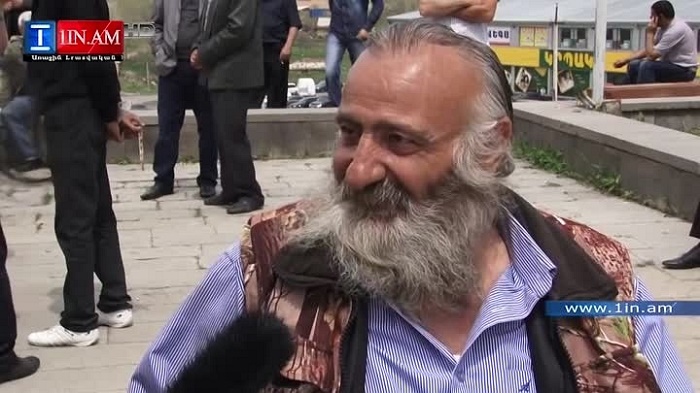
According to him, Azerbaijani intelligence is working well.
“Azerbaijani intelligence worked well enough. Had we prepared and been armed well, they would not have taken that step. The enemy spent the last 20 years arming and preparing themselves, while ours were busy plundering. It has been said many times that Azerbaijan is arming. Despite the ceasefire, the war has not ended. We must be ready for war at any time,” he said.
Bozinyan also commented on the seizure of 18 Armenian positions by Azerbaijani armed forces.
“Today, there are about five soldiers on duty in each army positions of Armenia. More soldiers should be on duty in our army positions,” the former fighter said.
He noted that over the past years, many people left Armenia and the birth rate declined in the country.
“We don’t have enough military equipment. We must be prepared to resist. The army must be strengthened before the state sitting at the negotiating table. A soldier must not think about weapons. It’s necessary to carry out military exercises. A soldier needs to know about modern weapons. We must appreciate the life of a soldier,” Bozinyan added.
He also recalled the ceasefire agreement signed between Armenia and Azerbaijan on May 12, 1994. “We had to then demand Azerbaijan’s recognition of the “independence” of Nagorno-Karabakh,” said the former fighter.
The Nagorno-Karabakh conflict entered its modern phase when the Armenian SRR made territorial claims against the Azerbaijani SSR in 1988.
A fierce war broke out between Azerbaijan and Armenia over the Nagorno-Karabakh region of Azerbaijan. As a result of the war, Armenian armed forces occupied some 20 percent of Azerbaijani territory which includes Nagorno-Karabakh and seven adjacent districts (Lachin, Kalbajar, Aghdam, Fuzuli, Jabrayil, Gubadli and Zangilan), and over a million Azerbaijanis became refugees and internally displaced people.
The military operations finally came to an end when Azerbaijan and Armenia signed a ceasefire agreement in Bishkek in 1994.
Dealing with the settlement of the Nagorno-Karabakh conflict is the OSCE Minsk Group, which was created after the meeting of the OSCE Ministerial Council in Helsinki on 24 March 1992. The Group’s members include Azerbaijan, Armenia, Russia, the United States, France, Italy, Germany, Turkey, Belarus, Finland and Sweden.
Besides, the OSCE Minsk Group has a co-chairmanship institution, comprised of Russian, US and French co-chairs, which began operating in 1996.
Resolutions 822, 853, 874 and 884 of the UN Security Council, which were passed in short intervals in 1993, and other resolutions adopted by the UN General Assembly, PACE, OSCE, OIC, and other organizations require Armenia to unconditionally withdraw its troops from Nagorno-Karabakh.
More about:


-1780923278.jpg&h=190&w=280&zc=1&q=100)