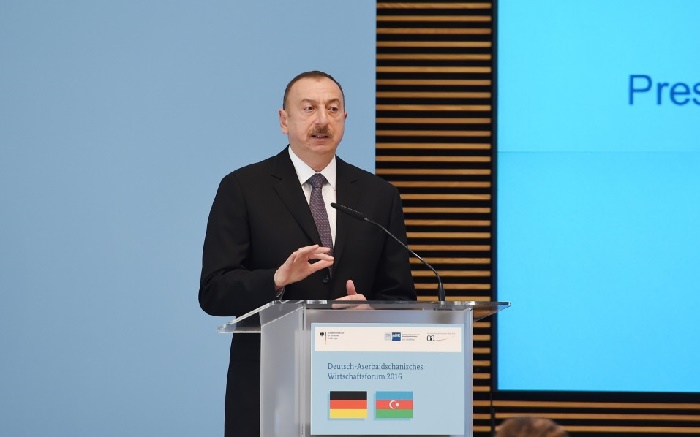
The ceasefire is very fragile, Armenia is unable to control the situation, and the status quo cannot continue this way, said Azerbaijan’s President Ilham Aliyev.
He made the remarks at the opening of the Azerbaijan-Germany Economic Forum in Berlin June 7.
The head of state stressed the importance of the withdrawal of Armenian armed forces from the occupied Azerbaijani territories, noting that the migration crisis that Europe is facing now is a problem that Azerbaijan experienced two decades ago.
The president said unfortunately Armenia has faced no sanctions for refusing to fulfill the UN Security Council resolutions on Nagorno-Karabakh.
“Early settlement of the conflict will serve stability in the region,” President Aliyev said, noting that despite the complicated situation, Azerbaijan is developing successfully.
According to him, massive political and economic reforms have been carried out and all freedoms ensured in the country over the last 25 years.
“We dedicated the period of ceasefire with Armenia to development of our country,” said Ilham Aliyev.
He added that Azerbaijan is playing a key role in implementation of global energy projects.
The Nagorno-Karabakh conflict entered its modern phase when the Armenian SRR made territorial claims against the Azerbaijani SSR in 1988.
A fierce war broke out between Azerbaijan and Armenia over the Nagorno-Karabakh region of Azerbaijan. As a result of the war, Armenian armed forces occupied some 20 percent of Azerbaijani territory which includes Nagorno-Karabakh and seven adjacent districts (Lachin, Kalbajar, Aghdam, Fuzuli, Jabrayil, Gubadli and Zangilan), and over a million Azerbaijanis became refugees and internally displaced people.
The military operations finally came to an end when Azerbaijan and Armenia signed a ceasefire agreement in Bishkek in 1994.
Dealing with the settlement of the Nagorno-Karabakh conflict is the OSCE Minsk Group, which was created after the meeting of the OSCE Ministerial Council in Helsinki on 24 March 1992. The Group’s members include Azerbaijan, Armenia, Russia, the United States, France, Italy, Germany, Turkey, Belarus, Finland and Sweden.
Besides, the OSCE Minsk Group has a co-chairmanship institution, comprised of Russian, US and French co-chairs, which began operating in 1996.
Resolutions 822, 853, 874 and 884 of the UN Security Council, which were passed in short intervals in 1993, and other resolutions adopted by the UN General Assembly, PACE, OSCE, OIC, and other organizations require Armenia to unconditionally withdraw its troops from Nagorno-Karabakh.
Ceasefire very fragile, Armenia unable to control situation - Azerbaijani president
07 June 2016
Read: 2663


-1780923278.jpg&h=190&w=280&zc=1&q=100)