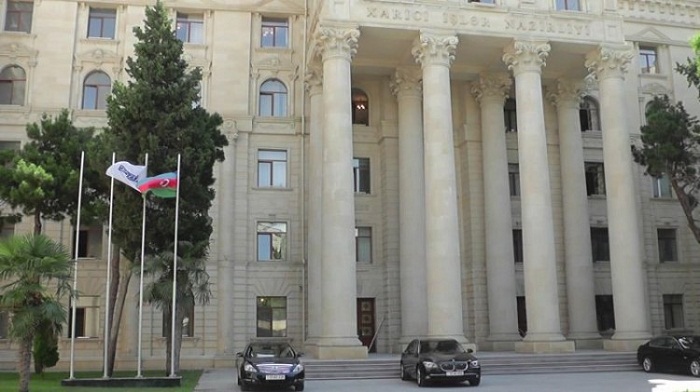
Audrys Antanaitis has appealed to the Azerbaijani foreign ministry with a request to exclude his name from the list.
In his letter confessing that he paid an illegal and intentional visit to the occupied territories of Azerbaijan by Armenia along with cameraman Arunas Sartanavichyus on May 7-10 without notifying the Azerbaijani side in advance, Audrys Antanaitis expressed his apology to the government and people of Azerbaijan for his unauthorized visit to the occupied territories of Azerbaijan.
Expressing regrets for their one-sided reports on the occupied territories of Azerbaijan, Audrys Antanaitis indicated his intention to visit Azerbaijan in order to deliver to the Lithuanian society more accurate and objective information about Azerbaijan, as well as the Armenia-Azerbaijan conflict.
After considering the Lithuanian journalist’s appeal, his name was excluded from the list of undesirable people of the Azerbaijani foreign ministry.
The Nagorno-Karabakh conflict entered its modern phase when the Armenian SRR made territorial claims against the Azerbaijani SSR in 1988.
A fierce war broke out between Azerbaijan and Armenia over the Nagorno-Karabakh region of Azerbaijan. As a result of the war, Armenian armed forces occupied some 20 percent of Azerbaijani territory which includes Nagorno-Karabakh and seven adjacent districts (Lachin, Kalbajar, Aghdam, Fuzuli, Jabrayil, Gubadli and Zangilan), and over a million Azerbaijanis became refugees and internally displaced people.
The military operations finally came to an end when Azerbaijan and Armenia signed a ceasefire agreement in Bishkek in 1994.
Dealing with the settlement of the Nagorno-Karabakh conflict is the OSCE Minsk Group, which was created after the meeting of the OSCE Ministerial Council in Helsinki on 24 March 1992. The Group’s members include Azerbaijan, Armenia, Russia, the United States, France, Italy, Germany, Turkey, Belarus, Finland and Sweden.
Besides, the OSCE Minsk Group has a co-chairmanship institution, comprised of Russian, US and French co-chairs, which began operating in 1996.
Resolutions 822, 853, 874 and 884 of the UN Security Council, which were passed in short intervals in 1993, and other resolutions adopted by the UN General Assembly, PACE, OSCE, OIC, and other organizations require Armenia to unconditionally withdraw its troops from Nagorno-Karabakh.
More about:


-1780923278.jpg&h=190&w=280&zc=1&q=100)