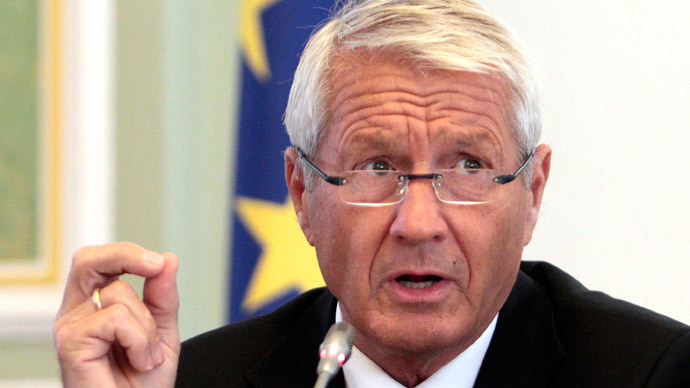
The Council of Europe doesn’t deal with the settlement of conflicts, including the Nagorno-Karabakh conflict, said the organization’s Secretary General Thorbjørn Jagland.
He was responding to the question from Ganira Pashayeva, a member of the Azerbaijani Delegation to PACE.
Pashayeva asked a question: “In January this year, PACE adopted the resolution #2058 on Sarsang reservoir, which calls on Armenia to stop the use of water resources "as a tool of political influence, or an instrument of pressure”. However, Armenia has not yet taken any steps to implement the resolution, and the districts inhabited by tens of thousands of people are still suffering from it. As a secretary general of the Council of Europe, what steps can you take to prevent this humanitarian disaster and how can you contribute to the solution of this problem?”
Jagland replied: “The OSCE Minsk Group has been entrusted of solving the Nagorno-Karabakh conflict. I reiterate that we don’t deal with the settlement of conflicts, including the Nagorno-Karabakh conflict. I have said several times that the OSCE Minsk Group is dealing with settlement of this conflict. They don’t want anyone else to interfere in the settlement process. We have to respect their decision. If they appeal to us to contribute to the Minsk process, then we certainly can do it. However, if they don’t want our participation in the settlement process, we cannot interfere in this process and create additional problems.”
The Nagorno-Karabakh conflict entered its modern phase when the Armenian SRR made territorial claims against the Azerbaijani SSR in 1988.
A fierce war broke out between Azerbaijan and Armenia over the Nagorno-Karabakh region of Azerbaijan. As a result of the war, Armenian armed forces occupied some 20 percent of Azerbaijani territory which includes Nagorno-Karabakh and seven adjacent districts (Lachin, Kalbajar, Aghdam, Fuzuli, Jabrayil, Gubadli and Zangilan), and over a million Azerbaijanis became refugees and internally displaced people.
The military operations finally came to an end when Azerbaijan and Armenia signed a ceasefire agreement in Bishkek in 1994.
Dealing with the settlement of the Nagorno-Karabakh conflict is the OSCE Minsk Group, which was created after the meeting of the OSCE Ministerial Council in Helsinki on 24 March 1992. The Group’s members include Azerbaijan, Armenia, Russia, the United States, France, Italy, Germany, Turkey, Belarus, Finland and Sweden.
Besides, the OSCE Minsk Group has a co-chairmanship institution, comprised of Russian, US and French co-chairs, which began operating in 1996.
Resolutions 822, 853, 874 and 884 of the UN Security Council, which were passed in short intervals in 1993, and other resolutions adopted by the UN General Assembly, PACE, OSCE, OIC, and other organizations require Armenia to unconditionally withdraw its troops from Nagorno-Karabakh.
`Council of Europe doesn
21 June 2016
Read: 1064


-1780923278.jpg&h=190&w=280&zc=1&q=100)