Ambassador Piotr Świtalski, Head of the European Union (EU) Delegation to Armenia, stated the above-said during Friday’s international conference on the local roots of global peace, AzVision.az reports citing the Armenian Media.
In his words, conflicts are a real threat to security in the region. Świtalski noted that the situation is at quite a risk, and we need to be hopeful that we become witnesses to a progress in the Nagorno-Karabakh peace process.
The EU diplomat also expressed the hope that significant results will be achieved in terms of the introduction of the measures to rebuild trust and mechanisms to investigate incidents along the line of contact of the Karabakh conflict zone, and also a visible progress toward a pacific settlement of the conflict.
The Nagorno-Karabakh conflict entered its modern phase when the Armenian SRR made territorial claims against the Azerbaijani SSR in 1988.
A fierce war broke out between Azerbaijan and Armenia over the Nagorno-Karabakh region of Azerbaijan. As a result of the war, Armenian armed forces occupied some 20 percent of Azerbaijani territory which includes Nagorno-Karabakh and seven adjacent districts (Lachin, Kalbajar, Aghdam, Fuzuli, Jabrayil, Gubadli and Zangilan), and over a million Azerbaijanis became refugees and internally displaced people.
The military operations finally came to an end when Azerbaijan and Armenia signed a ceasefire agreement in Bishkek in 1994.
Dealing with the settlement of the Nagorno-Karabakh conflict is the OSCE Minsk Group, which was created after the meeting of the OSCE Ministerial Council in Helsinki on 24 March 1992. The Group’s members include Azerbaijan, Armenia, Russia, the United States, France, Italy, Germany, Turkey, Belarus, Finland and Sweden.
Besides, the OSCE Minsk Group has a co-chairmanship institution, comprised of Russian, US and French co-chairs, which began operating in 1996.
Resolutions 822, 853, 874 and 884 of the UN Security Council, which were passed in short intervals in 1993, and other resolutions adopted by the UN General Assembly, PACE, OSCE, OIC, and other organizations require Armenia to unconditionally withdraw its troops from Nagorno-Karabakh.
Karabakh conflict may have implications for Europe and Eurasia - EU ambassador
24 June 2016
Read: 1332
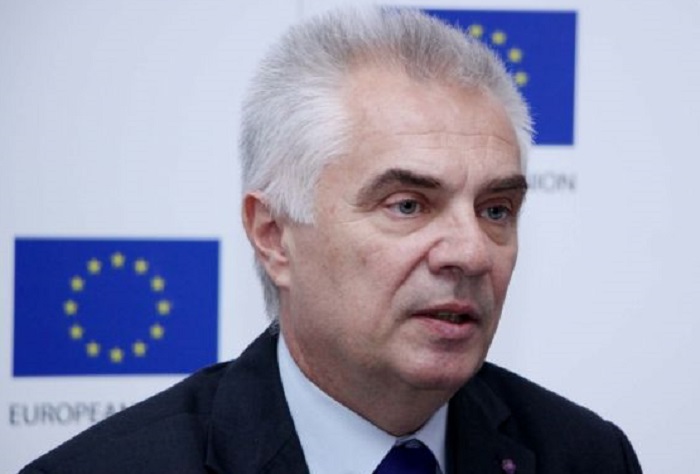
The Nagorno-Karabakh conflict may have implications for a wider security, even for Europe and Eurasia.


-1780923278.jpg&h=190&w=280&zc=1&q=100)