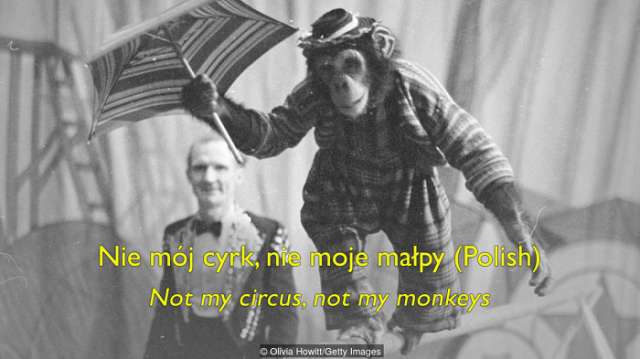
This phrase is used when you want to say that something isn`t your problem, so you`re indifferent to it. I have used it in my translations before without making any substitute for the literal meaning, because everyone understands the point, and the phrase is so funny.
Antonia Lloyd-Jones, co-chair of the Translators Association, Society of Authors
(Credit: Olivia Howitt/Alamy)
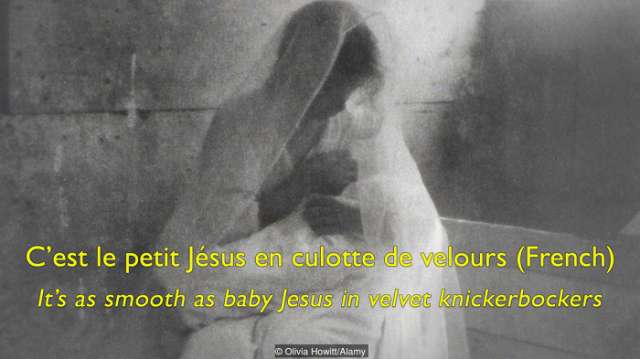
This is a French expression I love that’s used to describe a smooth wine.
Ros Schwartz, Society of Authors

I really like the Kiswahili (Swahili) word pole. It is a sort of greeting and a way of sympathising with someone in a wide variety of circumstances, and is of course hard to translate. You might say pole to someone carrying a heavy load (literally) but also if they give you bad news such as that they are ill or a relative has died. Pole can be emphasised using sana (‘very much’), as in pole sana.
Kim Sanderson, Institute of Translation and Interpreting, Society of Authors
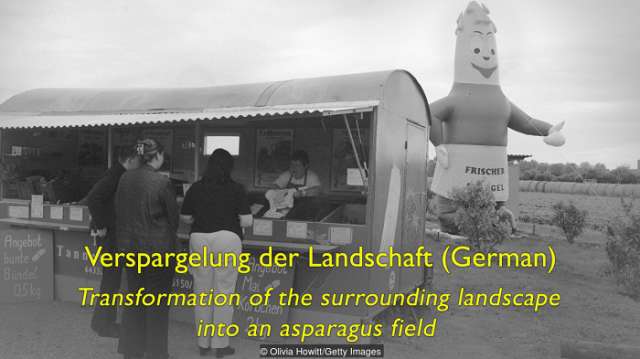
This is a pejorative phrase used to criticise the impact of wind farms on the landscape.
Judith Sauerzapf-Christopherson, Institute of Translation and Interpreting

The number of homonyms in Chinese makes punning easy, something that its netizens have exploited to the full in their battles with internet censors. One of the most famous creations is the 草泥��� or cǎonímǎ, which means ‘grass mud horse’. It is a play on the obscene homonym, 肏你妈 or cào nǐ mā (which ends ‘your mother’ and is not suitable for a family website). Invoking this mythical creature allows people in China to swear online without having their comments scratched by the censors.
Nicky Harman, Society of Authors
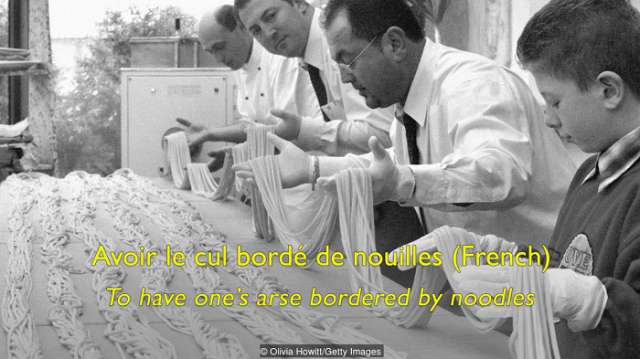
In terms of sayings, I must say that the French are the most inventive and creative people. This is my favourite saying, and it means to be extremely lucky. It might have various equivalents in other languages, though none as colourful…
Alina Cincan, Chartered Institute of Linguists
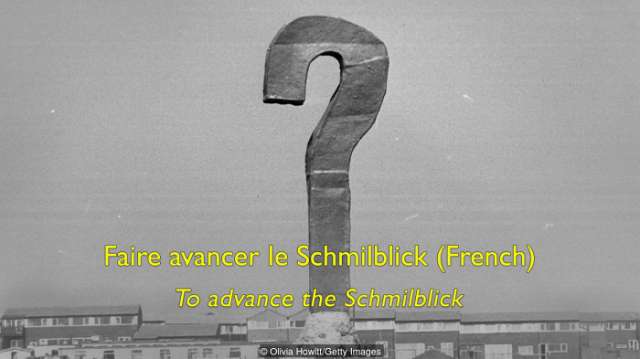
The Schmilblick is an imaginary object that is absolutely useless and is sometimes a synonym for ‘thing’. This expression is often used in French conversation when a group of people (of a certain age) are trying to figure something out with little to go on. A new but not very helpful suggestion or argument will be deemed ‘not to push the Schmilblick along’.
Louise Rogers Lalaurie, Society of Authors
This describes a person with high pretensions.
Louise Rogers Lalaurie, Society of Authors


-1780923278.jpg&h=190&w=280&zc=1&q=100)