He made the remarks at a panel session held in the framework of the international conference “Azerbaijan’s role on global and regional arena: Realities and Prospects” dedicated to the 25th anniversary of Azerbaijan’s independence.
The conference was organized by the Center for Strategic Researches under the President of the Republic of Azerbaijan.
He noted that Azerbaijan and Georgia are mutually dependent on each other.
“In the 1990s, these two countries were determined to establish a stable democratic state. However, we are faced with movements that are controlled from a single center. We realized that only together will we be able to maintain our independence and take our place on the international economic and political arena,” he said.
The Georgian expert further spoke about the Baku-Tbilisi-Ceyhan pipeline.
“At today`s event, I heard criticism against the US. In the 1990’s, I was a member of the Georgian government and I was participating in the negotiations on the draft. The US played an important role in the implementation of the Baku-Tbilisi-Ceyhan,” he said. “Russia was threatening us in order to prevent our participation in the Baku-Tbilisi-Ceyhan project. I would like to us and our Russian colleagues to say nice words to each other. However, the Kremlin still does not accept the independence of neighboring countries.”
According to him, the EU wants to see a stable state in the region.
“To what extent it can achieve this goal is another question. Here Sergey Markov tried to justify Russia’s occupation of Ukraine. In fact, Russia has forced President Viktor Yanukovych not to sign an association agreement with the European Union, so the crisis began in Ukraine. This is clearly indicative of Russia`s policy towards neighboring countries," he added.
Addressing the event, Stanislav Chernyavsky, director of the Center for Post-Soviet Studies at Moscow State Institute of International Relations, noted that Azerbaijan’s occupied lands must be returned so that the IDPs can go back their homes.
In his speech, Yerlan Karin, director of the Kazakhstan Institute for Strategic Studies under the President of the Republic of Kazakhstan, said Azerbaijan’s experience in reforms is being learned and applied.
“Azerbaijan has been able to preserve its unique cultural values, yet it is a modern, developing country. Many countries have failed to achieve it,” he added.
Javid Valiyev, a senior research fellow at the Center for Strategic Studies under the President of the Republic of Azerbaijan, spoke about the regional policy of Azerbaijan.
Following the discussions, Farhad Mammadov, director of the Center for Strategic Researches of Azerbaijan, made a closing speech.
“Russia was threatening Georgia in order to prevent its participation in BTC project”
07 October 2016
Read: 1739
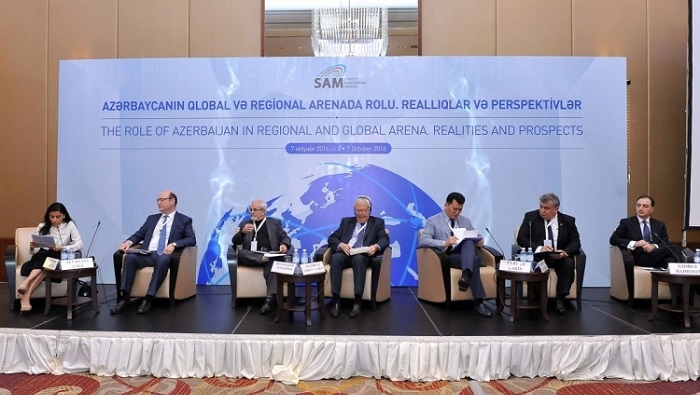
Russia was threatening Georgia in order to prevent its participation the Baku-Tbilisi-Ceyhan project, Giorgi Badridze, a senior fellow at Georgian Foundation for Strategic and International Studies, said in Baku Oct. 7.


-1780923278.jpg&h=190&w=280&zc=1&q=100)