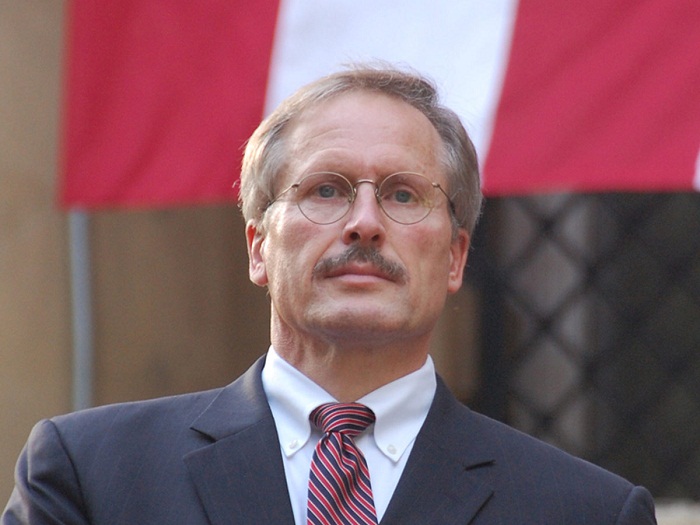
“Regarding the role of the OSCE Minsk Group co-chairs, I would say that we look to them to bring the sides together, to identify issues and see where there are ways the parties can move towards a settlement. However, as we have said in the past, the parties themselves are the only ones who can agree to a settlement; it cannot be achieved by force and it can’t be forced from outside,” said Cekuta. “And along these lines, I noted what Novruz Mammadov told the meeting this morning regarding Azerbaijan’s readiness to act to realize a peaceful settlement, something I will be, of course, reporting back to Washington.”
“We remain concerned about the incidents that continue to occur and that we deeply regret any loss of life in the Nagorno-Karabakh conflict and express our sincere and deepest condolences,” added the US ambassador.
The Nagorno-Karabakh conflict entered its modern phase when the Armenian SRR made territorial claims against the Azerbaijani SSR in 1988.
A fierce war broke out between Azerbaijan and Armenia over the Nagorno-Karabakh region of Azerbaijan. As a result of the war, Armenian armed forces occupied some 20 percent of Azerbaijani territory which includes Nagorno-Karabakh and seven adjacent districts (Lachin, Kalbajar, Aghdam, Fuzuli, Jabrayil, Gubadli and Zangilan), and over a million Azerbaijanis became refugees and internally displaced people.
The military operations finally came to an end when Azerbaijan and Armenia signed a ceasefire agreement in Bishkek in 1994.
Dealing with the settlement of the Nagorno-Karabakh conflict is the OSCE Minsk Group, which was created after the meeting of the CSCE (OSCE after the Budapest summit held in Dec.1994) Ministerial Council in Helsinki on 24 March 1992. The Group’s members include Azerbaijan, Armenia, Russia, the United States, France, Italy, Germany, Turkey, Belarus, Finland and Sweden.
Besides, the OSCE Minsk Group has a co-chairmanship institution, comprised of Russian, the US and French co-chairs, which began operating in 1996.
Resolutions 822, 853, 874 and 884 of the UN Security Council, which were passed in short intervals in 1993, and other resolutions adopted by the UN General Assembly, PACE, OSCE, OIC, and other organizations require Armenia to unconditionally withdraw its troops from Nagorno-Karabakh.
More about:


-1780923278.jpg&h=190&w=280&zc=1&q=100)