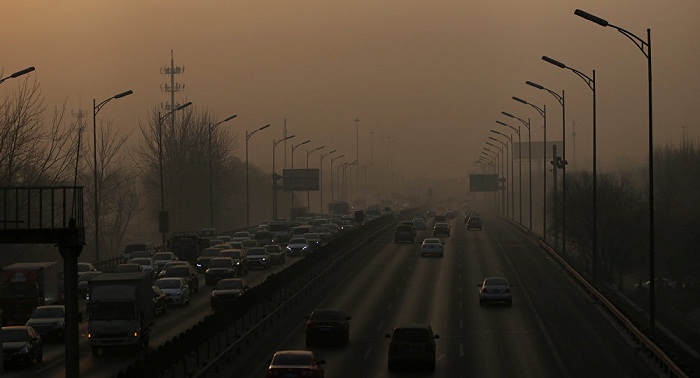
However, Wang and his colleagues discovered that in reality cars are far from being the only thing to blame for the situation.The researchers came to this conclusion after they monitored how and where airflows move in the lower atmospheric layers at the latitude of 500-1,000 meters, where the so-called atmospheric mixing layer is located. In that layer the gases rising from the earth’s surface are usually dispersed by winds.
This process is essential to the planet’s ecology because it makes polluted air masses above industrial centers and big cities disperse. However, the research has shown that the intensity of this process in the mixing layer as well as the layer’s height depend on how polluted the air in the region is. "Once the pollution is formed, the atmospheric mixing layer height will decrease quickly to 500 meters, and even lower and increase the pollutant concentration rapidly with compression mechanism,” Wang proved. “Meanwhile, the hygroscopic growth and heterogeneous chemical processes enhancement under the circumstance of high relative humidity will facilitate the explosive growth of secondary particulate matters.”
The researchers observed this mechanism in action when they were studying the formation of smog in Beijing and other cities of the North China Plain in October-November 2014.
At 500 meters height the winds do not blow as fast as they do at higher altitudes. As a result, the air masses brought by the wind from Beijing’s industrial suburbs cannot disperse quickly enough; they accumulate in the city’s air and mix up with aerosols and vapor to form the smog.
Thus, the trigger of smog formation is not cars in Beijing, but coal power plants and industrial factories in the suburbs. It means that the only way to fight the smog in the city is restrict not only the use of private cars, but also reduce coal and oil burning industries in the regions the air goes through before coming to Beijing.
The method, coupled with local emission control, would efficiently lower the peak values of contaminants, the scientists say. Their suggestion had been submitted to the Ministry of Environmental Protection.
More about:


-1780923278.jpg&h=190&w=280&zc=1&q=100)