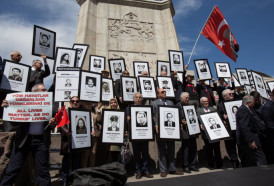
_1491562845.jpg "Aghdaban tragedy - facts and realities - VIDEO")
There was a farmstead of Damirchidam village, in the present territory of the village. In 1905, a number of families belonging to families of Delikli, Mammadli, Maharramli and Feyzalilar settled here. The village was called so, due to Agdaban Mountain. “Daban” means “mountain-pass”, “pass” in the Turkic language. As toponymy, it means “white mountain pass”, “whitish mountain-pass”. The word “Daban” is spread in a wide areal. There are mountains named Aghdaban in Azerbaijan (Aghdara, Sharur regions).
The offensive on Agdaban was reportedly carried out using the hit-and-run tactic used to inflict maximum damage but not remain in the location. Unlike in Khojaly, Armenian detachments did not follow the escaping civilians but managed set the village on fire. According to the former Kelbajar District Executive Committee Chairman and Agdaban native, Gambar Gurbanov, 53 out of 130 houses in the village were completely burned. Only after a defense committee in Kelbajar was formed and took charge of protecting the civilians, residents of Agdaban returned to the village. Up until its full occupation in1993, the village would serve as a frontline.
During the occupation 67 people were killed by the Armenians, 8 elders of 90-100 ages, 2 children, 7 women were burned alive, 12 people were seriously injured, and 2 people were missing. A part of rural population was killed in the ambush made in advance while trying to escape the violence.
In a way, occupation of Agdaban was a testing ground for the Armenian military to identify the extent and capability of Azerbaijani defense of the entire Kelbajar district and whether or not, heavy weaponry needed to be involved for its occupation. After the massacre in Agdaban, a special relief committee for the defense of Kelbajar was created and outskirts of Agdaban and other villages neighboring Armenian populated villages, were fortified. The defenders of Kelbajar district were able to withstand heavy Armenian offensives until March 1993. On March 23, Armenians launched a massive offensive on the entire district from east and west, effectively trapping the civilians and enforcements in the vast mountainous area. Agdaban was the first village to fall to the enemy.
Heavy artillery and reinforcements reportedly attacked from Vanadzor district of Republic of Armenia. The Armenian army aside, Russia’s 127th division assisted in the offensive, putting the Azeri chances for defense to zero. The only escape route was to the north through the frosty Omar pass, where hundreds fell dead to continuously shelled road and the Karabakh snow. Village by village, Armenians reached the provincial capital Kelbajar on April 2. Occupation of Kelbajar resulted in condemnation of Armenia’s aggression against Azerbaijan by the UN Security Council with its Resolution 822. That is when Turkey, then led by Turgut Ozal, demanded unconditional withdrawal of Armenian forces, and effectively closed the Armenian-Turkish border as a sign of protest.
Having been burned completely the second time in March 1993, Agdaban ceased to exist, but for its small community of survivors, it will always leave in their sorrow.
More about:


-1780923278.jpg&h=190&w=280&zc=1&q=100)