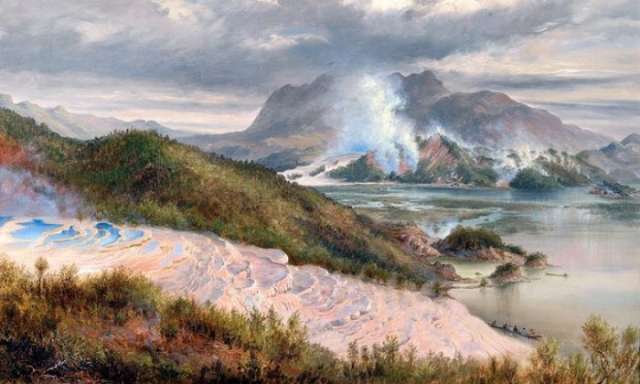
Two researchers think they have pinpointed the location where the terraces may lie preserved 32-49ft (10-15 metres) below the surface, under layers of mud and ash, and said a full archaeological survey is needed to excavate the site.
“They [the terraces] became the greatest tourist attraction in the southern hemisphere and the British Empire, and shiploads of tourists made the dangerous visit down from the UK, Europe and America to see them,” said Rex Bunn, one of the researchers. “But they were never surveyed by the government of the time, so there was no record of their latitude or longitude.”
Bunn and Dr Sascha Nolden believe the terraces were not destroyed or pushed to the bottom of the lake, as earlier research suggested, but are buried on the foreshore of the lake.
They used the field diaries of the German-Austrian geologist Ferdinand von Hochstetter, which contain a detailed description of the terraces’ location before the 1886 eruption, to establish their likely resting place.
“Our research relied on the only survey ever made of that part of New Zealand and therefore we are confident the cartography is sound,” Bunn said. “Hochstetter was a very competent cartographer.”
Since the pair’s research paper was published this month in the Journal of the Royal Society of New Zealand, Bunn said he had received daily offers of help to conduct a survey and was in the process of assembling a “team of the willing” to begin exploring the site, once the first funding goal of NZ$70,000 (£40,000) was met.
“We want to undertake this work in the public interest. And I have been closely liaising with the ancestral owners of the land, the Tuhourangi Tribal Authority, and they are supportive and delighted with the work,” he said.
Bunn believes the terraces may be in reasonable condition, potentially with minimal damage, and could be restored to their former glory once excavated.
This is not the first time researchers have claimed to have discovered the lost terraces. In 2011, scientists using an unmanned submarine said they had found remnants of them on the floor of the lake, buried by silt and debris.
Last year, GNS Science New Zealand said that after five years of research, a team of New Zealand and international scientists had come to the “inescapable conclusion” that most of the terraces had been destroyed by the eruption.
Bunn said he was in discussions with GNS and believed its conclusions were based on 130 years of inaccurate cartographical information.
More about: #New-Zealand


-1780923278.jpg&h=190&w=280&zc=1&q=100)