The U.S. military Stars and Stripes newspaper published an article on July 26 titled "Concerns raised over military presence, nukes stored in Turkey." The article is based on the opinions of analysts and former military officials and suggests "the U.S. should move its nuclear weapons from İncirlik Air Base and start looking for alternatives to the longtime military hub in Turkey, a country that can no longer be fully relied on." Even though the U.S military did not comment on the location of the nuclear warheads, experts and nuclear watchdog organizations believe that the U.S. military has about 50 nuclear warheads at İncirlik as well as around 2,500 troops. The article also suggests that U.S troops and nuclear warheads (B61 thermonuclear gravity bombs) can be moved from to Turkey to Greece, Bulgaria, Romania and even Jordan.
Commenting on claims regarding a possible U.S. withdrawal from İncirlik , a member of the Turkish Parliamentary Defense Committee, Hüseyin Kocabıyık, ruled out such a decision by the U.S administration. Kocabıyık asserted that if the U.S was to take the decision to pull out from İncirlik, Ankara would not exert efforts to persuade Washington to further stay at the air base. "If they withdraw from İncirlik Air Base, our response on the issue would be the same as we responded to Germany, namely goodbye," he said. "If someone tries to question Turkey's NATO membership by throwing out this allegation, I can answer by recalling former President and Prime Minister İsmet İnönü's renowned statement in 1964. İnonü said: 'A new world order will be established and Turkey will take its place there.' " İnönü made the remark back in 1964 when then U.S. President Lyndon B. Johnson sent a letter to him, urging the then Turkish government to not use NATO weapons in the Cypriot war and threatened to not defend Turkey in case of a Soviet attack when Turkey acts on its own in the Cyprus issue. Johnson's letter, considered one of the milestone events in Turkish-U.S relations, realized the importance of the national defense industry. Since then, İnonü's remarks have been used by politicians and academics from time to time to express that Turkey is not dependent on the U.S.
Allegations that the U.S will transfer nuclear weapons stationed in Turkey to other countries have been made periodically by foreign media outlets. In August 2016 an article published on EurActiv.com claimed that the U.S. has started transferring nuclear weapons stationed in Turkey to Romania. However, this claim was immediately denied by Romania's Defense Minister Mihnea Motoc. "There are no thoughts and no plans to take this direction. We can only call this information speculative," Motoc said. The Romanian Foreign Ministry also denied the claims. "[The] Romanian [Foreign Ministry] firmly dismisses the information you referred to," a Romanian Foreign Ministry spokesman told EurActiv.
In addition Dr. Jeffrey Lewis, director of the East Asia Nonproliferation Program at the Middlebury Institute of International Studies, also said that the U.S. has no intention of transferring its nuclear arsenal to Romania. "No, the U.S. is not moving its nuclear weapons from Turkey to Romania. For one thing, there are no Weapons Storage and Security System (WS3) vaults at Deveselu nor is there any place in Romania for storing the B61s," Lewis tweeted on his Twitter account.
The transfer of nuclear weapons stationed in Turkey to Romania and Bulgaria goes against the Mutual Relations, Cooperation and Security pact between NATO and the Russian Federation Agreement signed in 1997, an agreement in which NATO clearly declares that "the member states of NATO reiterate that they have no intentions, no plans and no reason to deploy nuclear weapons to the territory of new member states nor is there any need to change any aspect of NATO's nuclear posture or nuclear policy. We do not foresee any future need to do so." Romania and Bulgaria joined NATO on March 29, 2004 following the Prague Summit in November 2002.
Pentagon dismisses claims US looking for İncirlik alternatives
29 July 2017
Read: 1549
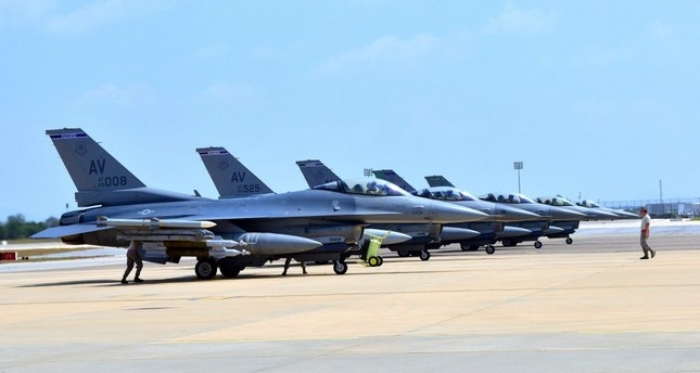
The Pentagon has dismissed allegations that the U.S. is planning to move its nuclear weapons from İncirlik Air Base and is looking for alternatives to the long-time military hub. "Turkey's İncirlik Air Base continues to fulfill an important role. We have no plan to move the U.S. forces there, and we remain committed to our NATO ally Turkey," Department of Defense (DoD) spokesman Johnny Michael told Daily Sabah on Friday.


-1780923278.jpg&h=190&w=280&zc=1&q=100)