However, the vessel, which was ambushed by the Royal Navy, suffered major damage in the Battle of River Plate and was forced to seek refuge in the neutral port of Montevideo for repairs to make her sea worthy.
The Royal Navy waited just outside Uruguayan territorial waters to attack the Graf Spee after it left port. However, Captain Hans Langsdorff scuttled the ship with a skeleton crew before it could be attacked - saving the vast majority of his crew.
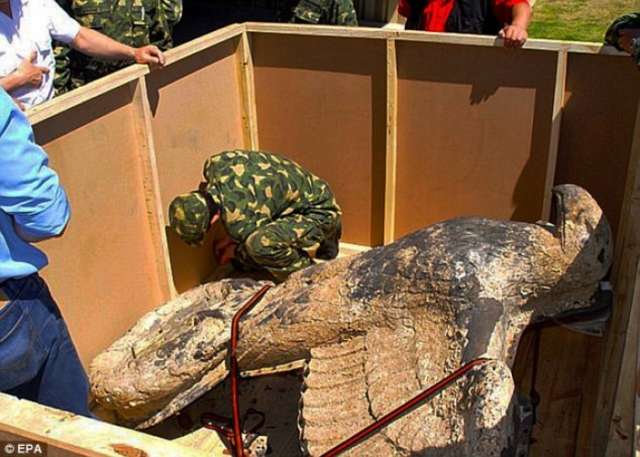
The giant bronze eagle and swastika - which weighs between 300 and 400 kilograms was recovered from the seabed by businessman Alfredo Etchegaray in 2006.
The Uruguayan Supreme Court ruled the Nazi artifact now belonged to the nation, although it admitted Mr Etchegaray should receive 50 per cent of the sale price for recovering the object from the seabed.
Mr Etchegaray previously told the BBC the eagle could be worth up to £10 million.
Captain Langsdorff scuttled his vessel to prevent the allies from accessing his state-of-the-art technology.
Although, he was condemned by the Nazi hierarchy for not rejoining battle with the Royal Navy and going down with his ship.
The German embassy in Montevideo has urged Uruguayan authorities not to put the object on public display because it could glorify the Nazi regime.
According to the BBC, Guido Westerwelle, who was the German foreign minister during a visit to Uruguay in 2010 told officials in Montevideo: 'We want the remains of the Graf Spee to be dealt with properly.
'We want to prevent wreckage from the ship, in particular the Nazi symbols, from landing on the market for military insignia.'
The Graf Spee's telemeter - which measured distance - is on display at the entrance to the city's harbour.
The confrontation was the first major naval battle of the war. It involved the heavy cruiser HMS Exeter and light cruisers HMS Ajax and Achilles.
The three Royal Navy vessels were considerably smaller and less well armed than the Graf Spee.
The Graf Spee hit HMS Exeter causing considerable damage as the first rounds of the 20-minute battle were fired.
Despite the theat, HMS Ajax and Achilles raced towards to German pocket battleship bringing it within the range of their guns.
However, it was HMS Exeter which caused the major damage on the German ship, which was forced to limp into Montevideo after being hit 20 times.
The Germans wanted 14 days to repair their damaged ship, but Uruguayan authorities, under pressure from the British, granted them 72 hours. If the Graf Spee was not able to return to see within that time, it was going to be interned for the duration of the war.
While raiding vessels in the south Atlantic, the Graf Spee sank 450,000 tonnes of shipping.
More about: #Uruguay


-1780923278.jpg&h=190&w=280&zc=1&q=100)