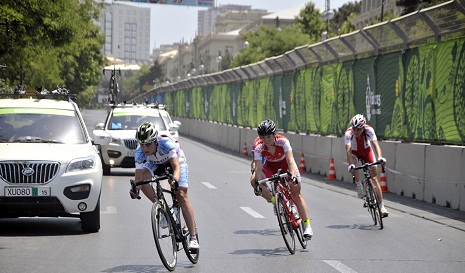
Since June 1, the State Administration Police have restricted the entry of vehicles and trucks, registered in the countryв`s regions to Baku, to ensure the uninterrupted movement of the 6,000 athletes, 3,000 delegations, and the mass of tourists in Baku for the Games.
Residents from the regions wishing to come into the city were asked to leave their cars parked at guarded lots in the north and west of the capital and use a special shuttle to get to the city.
Aliyev said that the temporary restrictions will run until July 10.
The government, however, is now considering the possibility of making the rules more permanent as the situation on Bakuв`s roads have improved dramatically.
``Prior to the restriction, up to 100,000 cars from the regions daily arrived in Baku,`` transportation expert Azer Allahveranov said. ``This increased traffic load on the capitalв`s roads by more than 40 percent. Currently, some 800,000 cars are registered in Baku. However, only 150,000 of them are constantly traveling on the road. Thus, 100,000 cars arriving in Baku from the regions make the situation on the roads of the capital very difficult.``
Everything will depend on the decision of the Security Committee of the Cabinet of Ministers, according to Aliyev. ``Now, the committee is holding a meeting on this issue.``
In order to create a safe, reliable, and accessible transport system for the increased numbers of passengers, exclusive ``Baku 2015 Lanes`` had been set during the Games for rapid movement of people, especially spectators and competitors. Drivers who violated these restrictions and unlawfully drove on the special lanes were fined 40 manats.
Now, the restriction works only for trucks, the spokesman stressed. ``They can use the lanes only after 10:00pm until morning. Those who violate the rule are fined for 40 manats,`` Aliyev said.
The first-ever European Games was surely a mega event, awarded to Baku by the European Olympic Committees (EOC) in December 2012.
Athletes competed in 20 sporting events, 16 of which were Olympic disciplines, while the other four were new sports to this format. Some 12 of them served as Olympic qualifiers for Rio 2016.
More about:


-1780923278.jpg&h=190&w=280&zc=1&q=100)