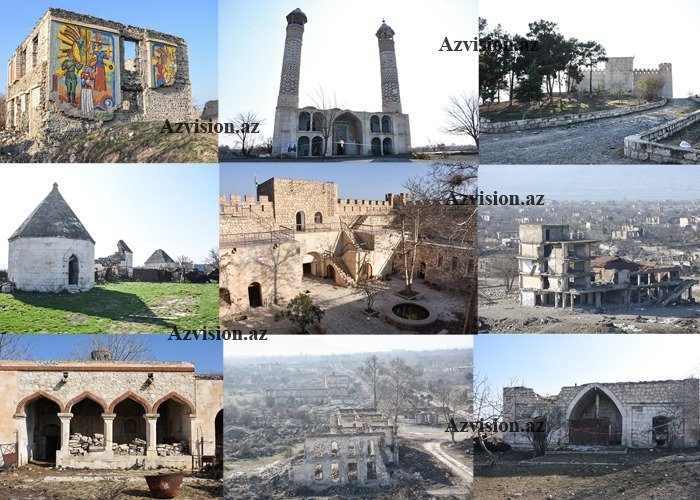
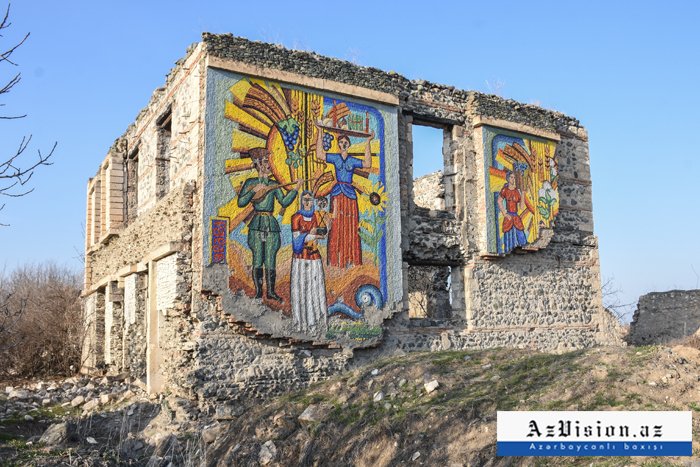
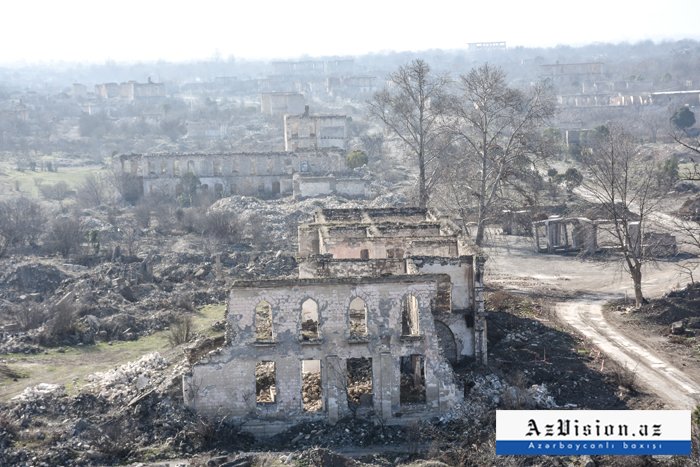
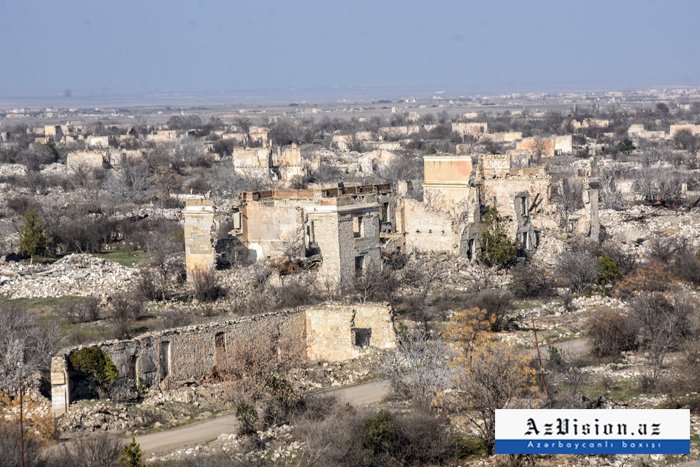
Before the occupation, there were factories, a railway station, a music school, agricultural schools and a theatre in Aghdam. Now they are replaced by ruins.
An inch of land in Aghdam is clear proof of Armenia’s slavery, vandalism and fascism. It is so difficult to imagine all this with words…
One of the historical buildings vandalized by Armenians in Aghdam is the Palace of Panahali Khan, the founder of the Garabagh Khanate. The monument dating back to the 18th century was desecrated by Armenian vandals.
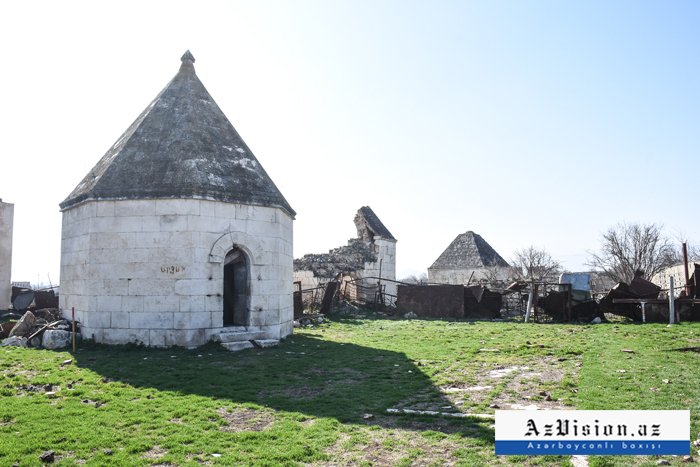
Destroyed tombstone of Azerbaijani poetess Natavan
The Imarat cemetery, which is located near the Khan’s Palace and where many members of the Garabagh khan dynasty were buried, was also vandalized by Armenians. Having ignored human values, the savage enemy destroyed the tomb of Ibrahimkhalil Khan and the gravestone of Khurshidbanu Natavan, the daughter of Mehdigulu Khan Javanshir, the last ruler of the Garabagh Khanate.
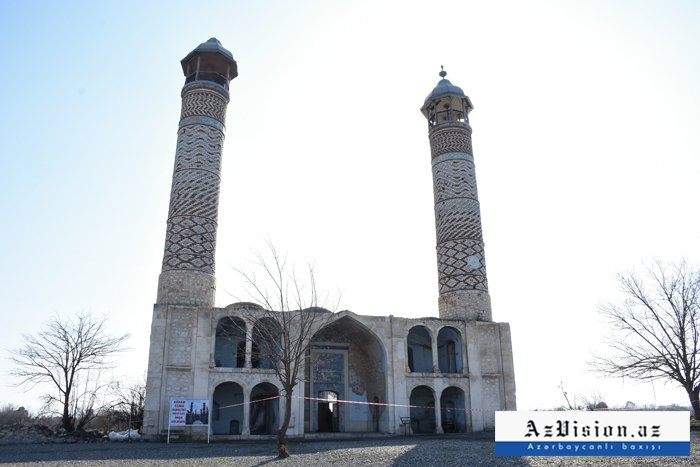
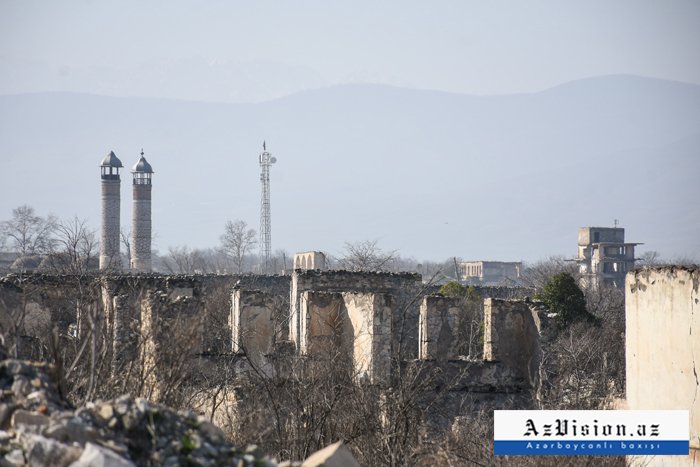
Nothing is left in Aghdam except the Juma Mosque. The Juma Mosque was built in 1868-1870 by architect Karbalayi Safikhan Garabaghi in a unique style. Similar mosques were also built in Barda, Shusha, Fuzuli and Horadiz.
Famous Juma Mosque, Aghdam
During the Armenian occupation, the minarets of the Juma Mosque in Aghdam were demolished, the ceiling was partially blown down, the interior design and wall inscriptions were destroyed. The mosque's belongings, technical equipment and facilities were looted and taken to Armenia. For many years, Armenians had been keeping cattle and pigs in the mosque, and the place of worship had been used as an animal stable.
The fact that the Armenians vandalized and destroyed religious and historical monuments of Azerbaijan during the years of occupation is an insult not only to Azerbaijan, but to all Muslim countries.
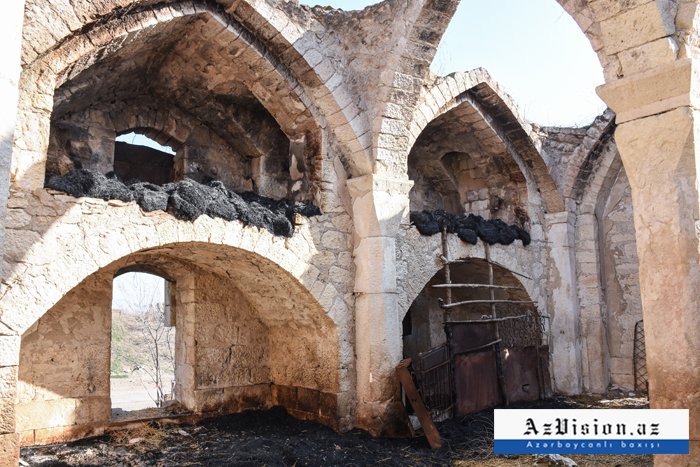
Then we visited a mosque in Aghdam’s Giyasli village. The Armenians had also been using this mosque as an animal stable.
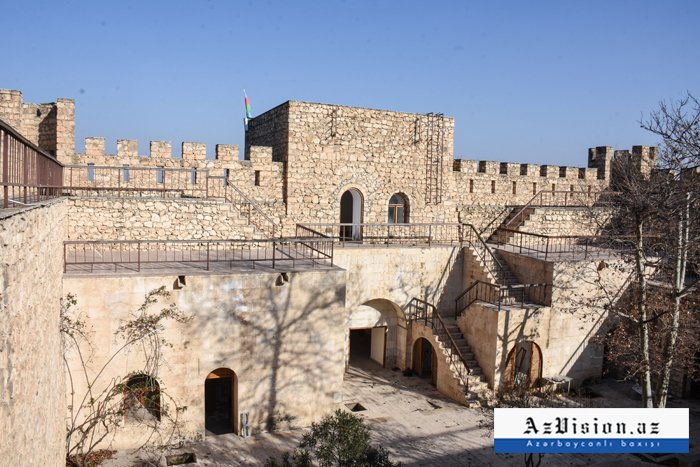
Panahali Khan’s fortress in Aghdam
We left the mosque in Giyasli village for the Shahbulag Fortress. Shahbulag Fortress (castle) was built near the city of Aghdam in 1750-1752 at the request of the Garabagh khan Panahali Khan.
After the occupation of the Aghdam district by the Armenian armed forces, the Shahbulag Fortress became the most Armenianized one of our monuments. Recently, the fortress was restored. Now is used as a church.
Aghdam Bread Museum
Our visit to the occupied lands continues. Now we are in the territory of the Aghdam Bread Museum, which was once the second in the world. The Armenians destroyed and looted this place as well. Such a museum opened for the first time in Ulm, Germany. The creation of the Aghdam Bread Museum was initiated by Sadig Murtuzayev, who served as the first secretary of the district party committee in 1982. The museum welcomed its first visitors on November 25, 1983. The Bread Museum was completely destroyed as the Armenian armed forces shelled Aghdam city in 1992.
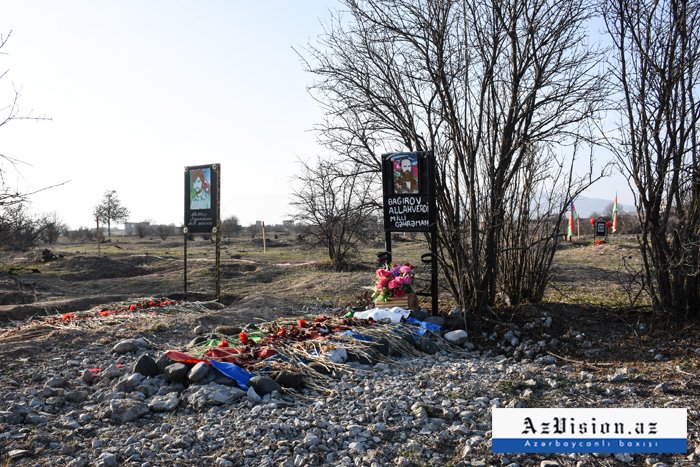
We also visited the grave of Azerbaijan’s National Hero Allahverdi Baghirov in the Alley of Martyrs in Aghdam. The Alley of Martyrs was razed to the ground by Armenian vandals.
Aghdam district was occupied on July 23, 1993. Only 22.6 percent of the district, with a population of 147,000, remained under Azerbaijan’s control. During the First Karabakh War, over 6,000 Azerbaijanis were martyred in the battles for Aghdam.
Before the occupation, in Aghdam there were 1,898 socio-economic facilities, 17 industrial, 31 construction, 753 trade, 397 public catering, 220 household enterprises, 480 social buildings, 22,446 residential buildings, 116 secondary schools, branches of several universities, 13 houses of culture, museums and 109 cultural clubs. The damage inflicted to Aghdam district as a result of the occupation is estimated at $252 million.
On November 20, 2020, Aghdam district was returned to Azerbaijan in accordance with a trilateral statement signed by the Azerbaijani, Russian and Armenian leaders following the 44-day Patriotic War.
AzVision.az
More about: Aghdam