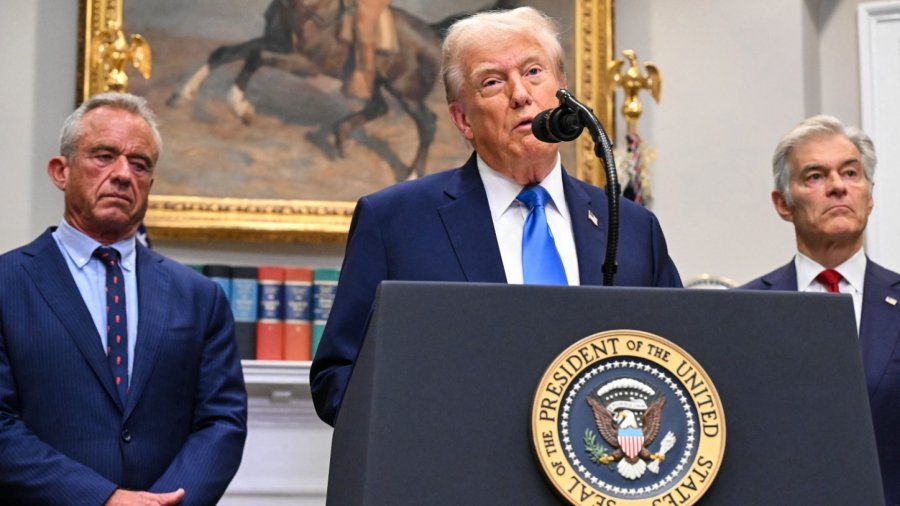
Doctors in the US will soon be advised not to prescribe the pain reliever Tylenol to pregnant women, US President Donald Trump said, citing a disputed link between the drug and autism.
The US president claimed on Monday that taking Tylenol, known as paracetamol elsewhere, "is no good" and that pregnant women should "fight like hell" to only take it in cases of extreme fever.
Medical experts have strongly pushed back on the claims, with some calling the president's comments dangerous.
Health officials in the UK have stressed that paracetamol remains the safest painkiller available to pregnant women.
UK Health Secretary Wes Streeting said: "I trust doctors over President Trump, frankly, on this."
The American College of Obstetricians and Gynecologists disputed the link made by Trump in the Oval Office on Monday.
Its president, Dr Steven Fleischman, said the Tylenol claim "is not backed by the full body of scientific evidence and dangerously simplifies the many and complex causes of neurologic challenges in children".
"Studies that have been conducted in the past, show no clear evidence that proves a direct relationship between the prudent use of acetaminophen during any trimester and fetal developmental issues," the statement added.
In a notice to doctors, the US Food and Drug Administration (FDA) used milder language than Trump.
The agency said doctors should consider limiting the use of Tylenol, while also taking into account that it is the safest over-the-counter option to treat fever and pain in pregnant women, which can also harm maternal and fetal health.
"To be clear, while an association between acetaminophen and autism has been described in many studies, a causal relationship has not been established and there are contrary studies in the scientific literature," the FDA wrote.
Speaking alongside Trump, Health Secretary Robert F Kennedy Jr said the FDA would also begin the process of initiating a safety label change on the medication and launch a public health campaign to spread awareness.
Tylenol is a popular brand of pain relief medication sold in the US, Canada and some other countries. Its active ingredient is acetaminophen, better known as paracetamol outside of North America.
The drug is recommended by other major medical groups as well as other governments around the world.
In a statement to the BBC, Tylenol maker Kenvue said the science clearly shows that taking acetaminophen does not cause autism.
"We strongly disagree with any suggestion otherwise and are deeply concerned with the health risk this poses for expecting mothers."
Kennedy added on Monday that the FDA would soon approve leucovorin, a decades-old drug traditionally used to protect cancer patients against toxicity from chemotherapy, to be used as treatment for children with autism.
FDA Commissioner Marty Makary said the approval will be based on research that he said suggests the drug may help children with autism who are deficient in folate, a form of vitamin B, improve their verbal communication.
But researchers have cautioned that the science is still in the very early stages, and more work is needed before any firm conclusions can be reached.
In April, Kennedy pledged "a massive testing and research effort" to determine the cause of autism in five months.
Trump on Monday called the rise in reported autism cases a "horrible crisis", and an issue that he has "very strong feelings about".
But experts have cautioned that finding the causes of autism - a complex syndrome that has been researched for decades - would not be simple.
The widely held view of researchers is that there is no single cause of autism, which is thought to be the result of a complex mix of genetic and environmental factors.
More about:


-1780923278.jpg&h=190&w=280&zc=1&q=100)