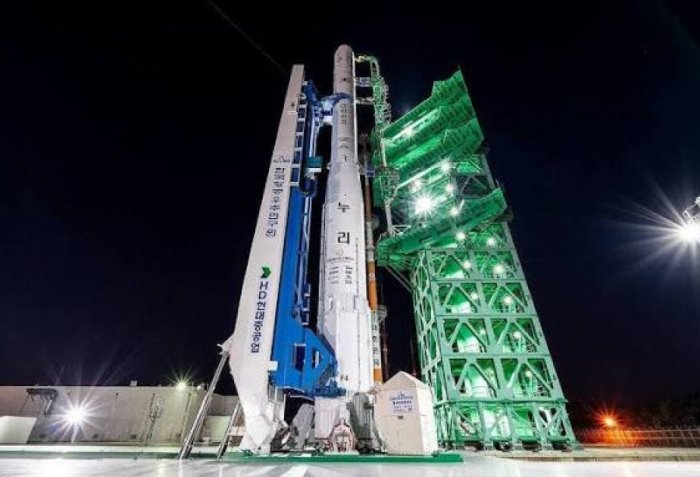
The 200-ton Nuri blasted off from the center in the country's southern coastal village of Goheung, some 330 kilometers south of Seoul, at 1:13 a.m., slightly behind the original plan of 12:55 a.m. due to a sensor issue.
According to the KASA and the Korea Aerospace Research Institute (KARI), the main satellite, CAS500-3, made communication with South Korea's research center in Antarctica at 1:55 a.m., allowing experts to check the unit's condition. "The fourth launch of Nuri was successful," Science Minister Bae Kyung-hoon said during a press briefing at the center, noting all satellites have been put into orbit.
"This was an important turning point in which the focus of the space ecosystem shifted to the private sector from the previous government-oriented approach," Bae added, noting the government will make efforts to become one of the world's top five space powerhouses in an unwavering manner. Yoon Young-bin, administrator of the Korea AeroSpace Administration (KASA), echoed the view, while stressing the government's plan to continue efforts to bolster South Korea's space exploration capabilities. President Lee Jae Myung hailed the successful launch of Nuri in a social media post, calling it "a moment that opens a new chapter" in the country's space exploration history. Researchers will continue to monitor the main satellite through communication with other ground stations, including those in the central city of Daejeon and Norway, space authorities added. The CAS500-3, built by Korea Aerospace Industries Co., is a medium-class satellite unit developed using the standard platform technology from the first CAS500 model.
The satellite will conduct observations of Earth's auroras and upper atmosphere, and be used in various experiments, including the verification of three-dimensional stem cell cultivation using bio 3D-printing technology. About two minutes after liftoff, Nuri separated the first stage, followed by the second-stage four minutes and 30 seconds into the flight. After reaching the target altitude of 600 km, Nuri separated the main satellite, along with 12 cube satellites. The main satellite will be tasked with conducting space science research, including measurement of space magnetic fields and plasma along with observation of auroras.
AzVision.az
More about: SouthKorea


-1780923278.jpg&h=190&w=280&zc=1&q=100)