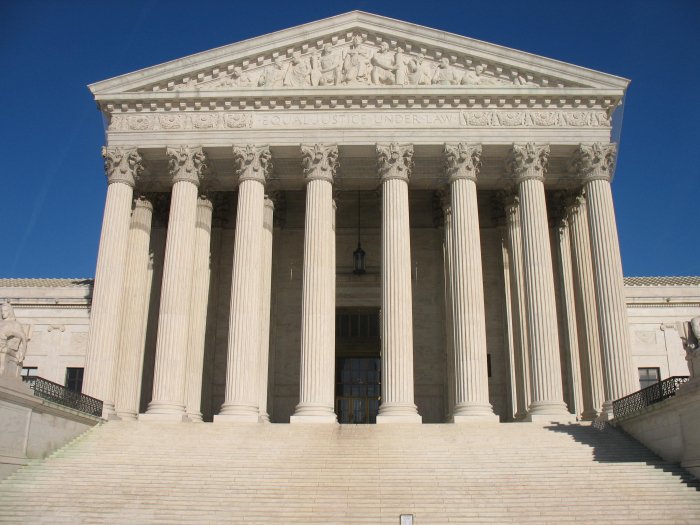
In striking down a large chunk of President Donald Trump’s tariffs Friday, the Supreme Court set up a new legal battle over the $130 billion-plus the government has collected from those duties.
The justices, in their 6-3 ruling, did not order the Trump administration to provide refunds to importers for the tariffs already paid, or spell out how repayment should work. That likely leaves the U.S. Court of International Trade responsible for sorting out a thicket of legal issues related to possible repayments; under customs law, tariff refund claims are typically handled through that trade-focused, New York-based court and processed by U.S. Customs and Border Protection.
The president himself lamented the court’s omission in a press conference Friday afternoon. “They take months and months to write an opinion and they don’t even discuss that point,” he told reporters at the White House. “Wouldn’t you think they would have put one sentence in there saying that, ‘keep the money’ or ‘don’t keep the money,’ right? I guess it has to get litigated for the next two years.”
In a dissenting opinion, Justice Brett Kavanaugh warned the refund process will be a “mess” — echoing Justice Amy Coney Barrett’s description during oral arguments. Barrett, nonetheless, joined the majority ruling against Trump’s duties.
“The Court says nothing today about whether, and if so how, the Government should go about returning the billions of dollars that it has collected from importers,” Kavanaugh wrote, adding that “refunds of billions of dollars would have significant consequences for the U.S. Treasury.”
That’s a point the president and other senior economic officials made repeatedly in the build-up to the court’s decision. In a Truth Social post last month, Trump warned that striking down the tariffs could force the U.S. to repay “many Hundreds of Billions of Dollars” — potentially “Trillions” when accounting for related investments — calling such a scenario “a complete mess” that would be “almost impossible for our Country to pay.”
Trade and customs experts agree any potential repayment process will be a logistical “nightmare” for both the federal government and the companies seeking compensation — and that legal fights are likely.
“I would assume that the Trump people will fight the idea of refunds, and that’ll be the next thing that’ll go winding through the courts,” Trump’s first-term Commerce Secretary Wilbur Ross said in an interview. “There will be more litigation.”
That would create a “particularly unfair burden for smaller importers,” said Scott Lincicome, vice president of general economics at the libertarian Cato Institute, noting they “lack the resources to litigate tariff refund claims.”
The Justice Department and parties in the tariff litigation have already asked the Court of International Trade to establish a steering committee to coordinate the more than 1,000 refund-related cases now pending, a common step in large, complex trade disputes.
In court filings, the DOJ has acknowledged that if the tariffs are ruled unlawful, importers would likely be entitled to refunds, which CBP would process, primarily via its Automated Commercial Environment system, as the agency transitions to fully electronic refund payments.
“Customs is setting up a process for importers to collect refunds. Those refunds will be processed over time, so there won’t be a sudden, overnight windfall to importers,” said Nazak Nikakhtar, who worked on trade issues at the Commerce Department during the first Trump administration and is now a partner at the law firm Wiley Rein. “Their customers, however, who hadn’t independently negotiated tariff refunds might be left without any recourse.”
Industry groups are already pressing the Trump administration to swiftly issue refunds.
“We are confident in Customs and Border Protection’s (CBP’s) ability to move quickly and provide clear guidance to American businesses on how to obtain refunds for tariffs that were unlawfully collected,” American Apparel & Footwear Association President Steve Lamar said in a statement.
Trump on Friday did not indicate that was likely. Asked directly whether he planned to offer refunds to companies who paid the tariffs over the past several months, the president replied: “I told you the answer, it’s not discussed [in the ruling]. We’ll end up being in court for the next five years.”
Politico
More about:


-1780923278.jpg&h=190&w=280&zc=1&q=100)